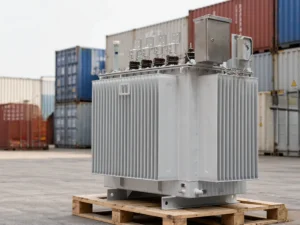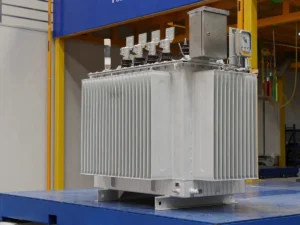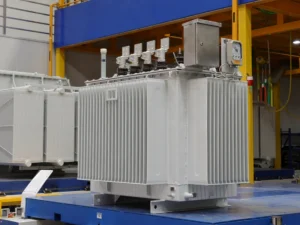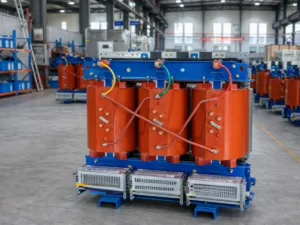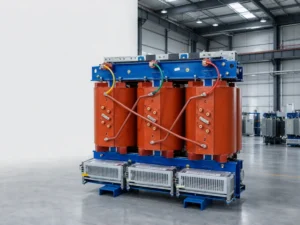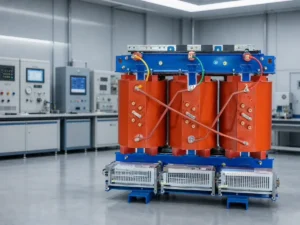
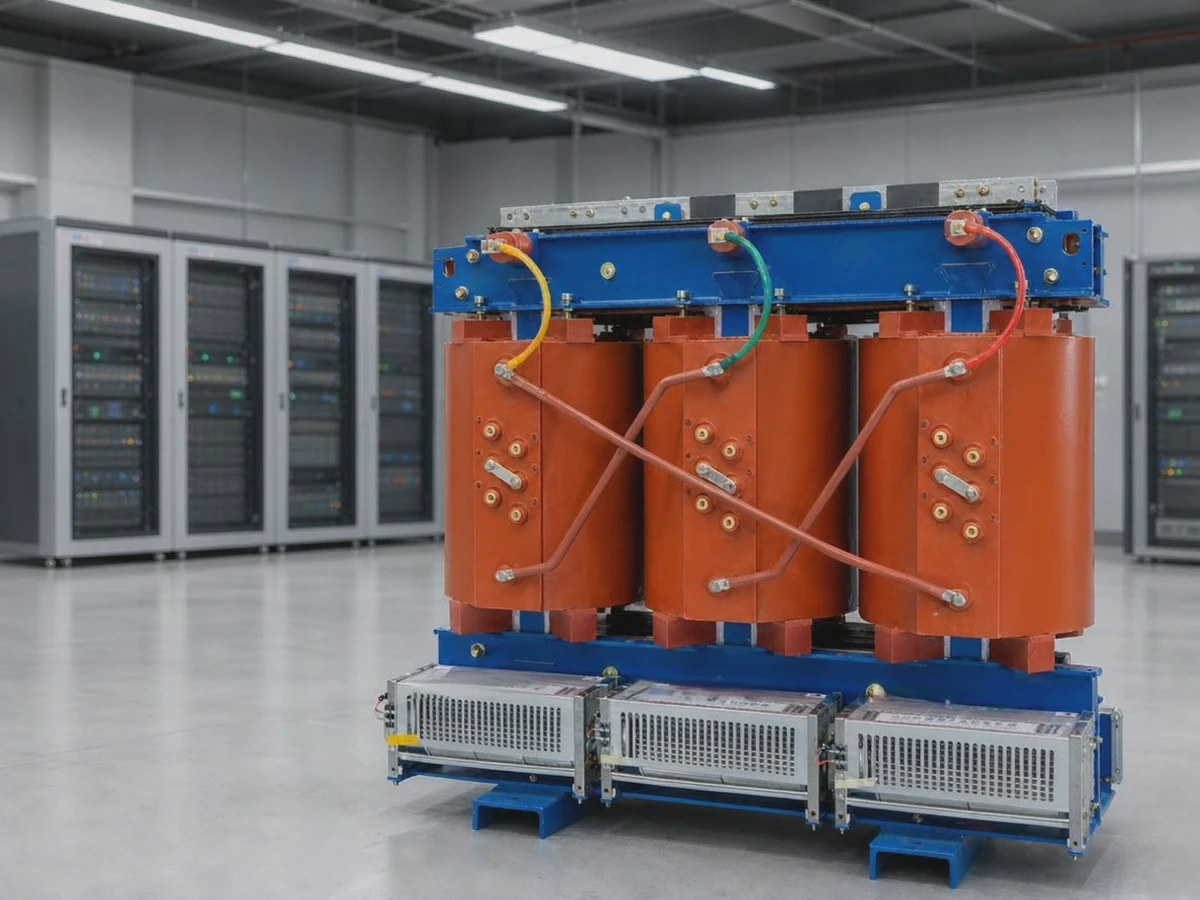
A data center transformer is the first piece of power equipment that shapes utility power into something your IT load can actually use. In a facility where a single unplanned outage can cost far more than the equipment itself, the transformer is not just a line item — it is part of the availability chain. This guide explains where the transformer sits in the power path, why indoor data halls favor dry-type units, how redundancy topologies change the specification, and what to check before you issue an RFQ. Daqo Group draws on more than 30 years in the transformer industry to keep the guidance practical and standards-based.
Những điểm chính cần ghi nhớ
- The front-end transformer feeds the UPS; its impedance, loss profile and thermal rating affect the whole downstream power chain.
- Indoor data halls overwhelmingly use dry-type units because they contain no free oil and present a much lower fire load.
- Cast resin and vacuum pressure impregnated (VPI) windings are the two common dry-type constructions; choose based on moisture, temperature and maintenance access.
- Redundancy (2N, N+1, distributed redundant) changes how many transformers you need and how each one is rated.
- Harmonic-rich IT loads drive derating and neutral-sizing decisions — size from measured load, not nameplate assumptions.
- Specify fire rating, acoustics and temperature class early; retrofitting them later is expensive.
Why Data Centers Need a Purpose-Built Data Center Transformer
A general-purpose distribution transformer and a data center transformer may look similar on the outside, but they are specified differently. Data center loads are dense, continuous and increasingly nonlinear. They run near full capacity for thousands of hours a year, they generate harmonics that a generic thermal model may underestimate, and they sit inside buildings where fire and smoke behavior matters as much as electrical performance.
Three requirements separate a critical-power transformer from an ordinary one. First, availability: the unit must stay online through load steps and mild utility disturbances without nuisance trips. Second, fire safety: the transformer must not become the ignition source or the fuel source in a room full of cable, plastic and electronics. Third, serviceability: the specification must allow inspection and testing without shutting down the entire hall. If you are still deciding between the broad technology families, our transformer types selection guide compares dry-type, oil-immersed and padmount options side by side.
Where the Transformer Sits in the Data Center Power Path
Understanding the topology is the first step to specifying the right unit. Utility power typically arrives at medium voltage, is stepped down by a front-end transformer, passes through switchgear and into the UPS, and is then distributed at low voltage to server rows. A simplified path looks like this:
Utility feed → MV switchgear → Front-end transformer → LV switchboard → UPS → Distribution → IT load
Depending on the design, a second transformer may sit downstream of the UPS to create a separate voltage zone, and additional units feed mechanical systems such as chillers and pumps. Each location has a different duty.
The front-end transformer
The front-end transformer sets the voltage that the UPS sees. Its short-circuit impedance influences fault current available to downstream breakers, and its temperature rise determines how much continuous current it can carry in a warm electrical room. Because it operates at high load factor for long periods, efficiency is worth more here than in a lightly loaded substation unit — every point of loss becomes heat that the building’s cooling system must remove.
Distribution transformers near the load
Larger campuses sometimes step voltage down again closer to the white space. These units must be quiet, compact and easy to isolate. Location drives the enclosure type, the cooling method and the acoustic treatment far more than the electrical rating does.
Mechanical and auxiliary loads
Chillers, fans and pumps are mostly linear motor loads. They can often use a more conventional transformer than the IT path, and separating them from the IT transformer improves fault isolation and makes energy metering cleaner.
How to Specify the Right Data Center Transformer
This is the section to return to when you turn a concept into a purchase order. A complete specification covers electrical ratings, thermal performance, construction, fire behavior and installation constraints.
Start with measured load, not a rule of thumb
Build a load profile that includes current demand, expected growth and harmonic content. IT equipment with switch-mode power supplies draws current in short pulses, which raises heating in the windings and the neutral conductor. The topic is covered in more depth in our how to size a transformer guide, but the practical rule for data centers is simple: measure or conservatively model harmonics before you fix the kVA rating. An underspecified unit runs hot; an overspecified unit wastes capital and operates at low efficiency.
Efficiency and heat rejection
No-load loss is incurred whenever the transformer is energized, while load loss scales with the square of current. A data center transformer is energized around the clock, so no-load loss deserves real attention. Lower losses reduce the building’s cooling burden and improve overall power usage effectiveness. Ask for loss figures at the specified load profile rather than accepting a single efficiency number at a convenient operating point.
Impedance and protection coordination
Short-circuit impedance is a balancing act. Low impedance improves voltage regulation and limits voltage drop under load steps, but it raises prospective fault current and may force larger, more expensive switchgear. Higher impedance limits fault current but allows more voltage sag. Agree the impedance with the protection engineer early, because it affects breaker interrupting ratings and selective coordination studies.
Temperature class and cooling
Dry-type units are commonly supplied with natural convection cooling and forced-air assistance. Forced air can raise the continuous rating, but it adds fans, noise and another failure mode. Decide whether the extra capacity is worth the complexity, and confirm that the temperature class of the insulation system matches the hottest spot you expect under your actual load and ambient conditions.
Fire Safety: Why Indoor Halls Favor Dry-Type Construction
Fire safety is the single strongest reason data centers choose dry-type transformers. A liquid-filled unit contains combustible oil; if it fails internally, that oil can feed a fire and complicate cleanup. A dry-type transformer contains no free oil, so it removes the fuel source from the equation. This is why indoor transformer rooms in office-style data centers are almost always dry-type. Our overview of dry-type transformers in data centers and fire safety goes deeper into the code-driven reasons, and the broader topic of dry-type transformer fire protection covers design and suppression considerations.
Cast resin versus VPI windings
Two construction methods dominate. Cast resin windings encapsulate the conductors in epoxy under vacuum, producing a rigid, sealed coil with strong short-circuit withstand and good resistance to moisture and contaminants. Vacuum pressure impregnated windings use an insulating varnish that is cured after impregnation; they are typically lighter and easier to repair but depend more on the surrounding environment for protection. In a clean, climate-controlled data hall both work well; in a damp basement or a dusty industrial adjacency, cast resin usually earns its premium.
What the codes actually care about
Building and electrical codes treat transformers indoors as a fire-load question. Requirements commonly address fire-resistant separations, ventilation, and whether the unit is in a dedicated room. The exact rules depend on jurisdiction and rating, so have the authority having jurisdiction confirm the interpretation for your site. Linking the transformer choice to the fire strategy early avoids late redesign of rooms and penetrations.
Redundancy and Topology: 2N, N+1 and Distributed Redundant
Redundancy is not an accessory you bolt onto a transformer — it determines how many transformers you buy and how each is loaded.
- 2N (double active capacity): two full-capacity systems, each able to carry the entire load. Each transformer normally runs at roughly half load. Highest availability, highest capital and space cost.
- N+1: N units serve the load and one spare stands by. Cheaper than 2N, but the spare must be accessible and the failure of one unit leaves no further margin.
- Distributed redundant: several smaller units feed a common bus, with capacity to lose one or more. Popular in large halls because it improves maintainability and fault isolation.
When evaluating topologies, model the failure case, not just normal operation. A transformer that runs comfortably at 45 percent load in normal mode may be asked to carry 90 percent during a maintenance concurrency event. Confirm that the thermal rating and cooling strategy still hold under that condition, and that the protection settings remain selective.
Comparison: Dry-Type vs Oil-Filled for Data Center Service
| Criterion | Cast resin dry-type | Liquid-filled (oil) |
|---|---|---|
| Typical placement | Indoor, near load | Outdoor or dedicated vault |
| Fire fuel source | None (no free oil) | Combustible oil present |
| Moisture/dust tolerance | High when encapsulated | Sealed tank; depends on seals |
| Tiếng ồn | Low to moderate; fans add noise | Generally quiet |
| Maintenance access | Simple visual and thermal checks | Oil testing and leak management |
| Overload headroom | Limited by insulation temperature class | Greater thermal mass, but oil aging |
| Phù hợp nhất | White-space and electrical rooms | Utility intake and outdoor yards |
For most indoor data center applications the dry-type column wins on safety and siting flexibility. Liquid-filled units still make sense at the utility intake where outdoor placement is available and the fire separation is straightforward.
Design Features Worth Specifying Explicitly
Vague specifications invite substitutions. Call out the features that matter to your operation, and point suppliers to documented key dry-type transformer designs so everyone is comparing like with like.
- Winding conductor material and temperature class, stated explicitly.
- Temperature rise limits at the declared ambient, not just at a reference condition.
- Cooling modes available and whether forced air is factory-fitted or field-addable.
- Tap changer range and step size, with off-circuit or on-load type stated.
- Enclosure type, ingress protection and any acoustic treatment.
- Termination layout and cable entry direction to match the room.
- Sensor provisions for winding temperature monitoring and remote alarm.
- Factory test list, including temperature rise, impedance and partial discharge where relevant.
Daqo Group’s máy biến áp khô range and máy biến áp khô bằng nhựa đúc are built to common IEEE, IEC and ANSI expectations; confirm the exact configuration against your project standards during quotation.
Installation and Commissioning Checks
Even a well-specified transformer can underperform if installation is rushed. Verify the room’s ventilation path, confirm clearances for cooling airflow, and check that the foundation and lifting points suit the unit. At commissioning, record winding resistance, insulation resistance, ratio and vector group, and compare them with factory values. Baseline thermal images under load give you a reference for future condition monitoring. Document everything — in a critical-power facility the commissioning record is the starting point for the asset’s entire life.
Common Specification Mistakes
- Sizing from connected load: connected load almost always overstates real demand; use measured or diversified figures.
- Ignoring harmonics: nonlinear IT load creates extra heating that a purely resistive model misses.
- Forcing air without a plan: fans need power, filtration and a failure alarm, or they become a hidden single point of failure.
- Overlooking acoustics: a transformer that meets electrical specs can still violate an office-adjacent noise limit.
- Buying on price alone: in a 24/7 facility, losses and downtime dominate lifetime cost.
Phần kết luận
A data center transformer is a reliability component as much as an electrical one. Specify it from the measured load, choose dry-type construction for indoor fire safety, align it with the redundancy topology, and lock down thermal, acoustic and protection requirements before you order. Doing that homework turns the transformer from a risk into a quiet, predictable part of your availability chain. If you want to review a specific duty against our dry-type transformer portfolio or discuss a custom configuration, the engineering team is ready to help — see the contact details below.
Câu hỏi thường gặp
1. Why do data centers use dry-type transformers instead of oil-filled ones?
Because indoor halls are occupied spaces with significant cable and plastic fire load. A dry-type transformer has no free oil, so it removes a fuel source and simplifies fire separation. Liquid-filled units remain common at outdoor utility intakes where separation is easy to achieve.
2. What size data center transformer do I need?
Size from measured demand plus growth margin, and account for harmonic heating and neutral current. Do not simply add up connected nameplate ratings. Our companion transformer sizing guide walks through the calculation.
3. Does a data center transformer need forced-air cooling?
Not always. Natural convection may cover the duty at the specified ambient. Forced air adds capacity but also fans, noise and a failure mode, so it should be justified by a load or ambient study rather than added by default.
4. How does 2N redundancy affect transformer rating?
In a 2N design each system carries full load, so each transformer is typically sized for 100 percent of the load and runs at roughly half load normally. That gives strong availability but increases capital and space.
5. What is a cast resin transformer and why is it common in data centers?
It is a dry-type transformer whose windings are encapsulated in epoxy under vacuum. The sealed coil resists moisture and contaminants and has strong short-circuit withstand, which suits controlled indoor environments.
6. How important is efficiency for a data center transformer?
Very. The unit runs continuously, so no-load loss accumulates every hour and becomes heat the building must remove. Evaluate losses across your real load profile, not just at a single nameplate point.
7. What tests should a factory acceptance test include?
Typical routine tests include winding resistance, ratio and vector group, insulation resistance, impedance voltage and load/no-load loss measurement. Temperature rise and partial discharge are often requested for critical installations; agree the list before production.
8. Can an existing data center transformer be upgraded rather than replaced?
Sometimes. Forced-air retrofits, improved monitoring or load redistribution can buy capacity, but they must be validated against insulation temperature class and fire approvals. If the core design is undersized, replacement is usually the safer path.
Talk to an Engineer
Every data center has a different load profile, redundancy target and fire strategy. To review your duty and get a configuration matched to your project standards, contact our engineering team with your single-line diagram and load data.