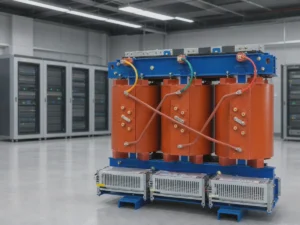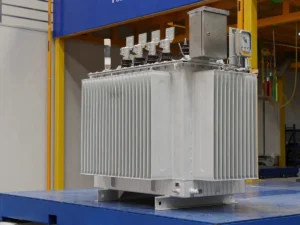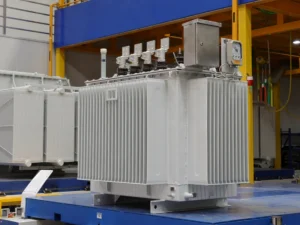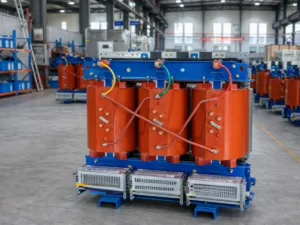
When a buyer in Houston orders a transformer from a factory in Shanghai, two numbers create more engineering risk than almost any others on the datasheet: voltage and frequency. Understanding transformer voltage standards 50Hz 60Hz is the first step in any export project, because a unit designed for one region cannot simply be relabeled for another. The windings, core flux density, impedance, cooling, vector group, and even the test procedure all depend on the grid it will connect to. This guide explains how voltage levels, frequency, and connection conventions differ between North America and Europe, and how specifiers can avoid costly mismatches before a single sheet of steel is cut.
Wichtigste Erkenntnisse
- Frequency is not interchangeable: a 60 Hz transformer generally cannot run at full rating on 50 Hz without derating, while a 50 Hz design usually tolerates 60 Hz.
- North America uses 60 Hz and ANSI/IEEE/NEMA conventions; most of Europe uses 50 Hz and IEC 60076 conventions.
- Voltage classes, vector groups, and tap-changer ranges differ by region and must be confirmed against the actual utility supply.
- Automotive, data center, and renewable projects often add regional certification layers on top of the base standard.
- Always issue a single consolidated specification sheet before manufacturing; assumptions at the enquiry stage are the main source of export rework.
Why Regional Standards Matter in Transformer Export
A transformer is a custom-engineered product, not a commodity that can be shipped from a catalog. Every grid has its own voltage classes, frequency, fault levels, grounding philosophy, and approved equipment standards. A unit that meets one set of rules may be technically unacceptable — or even unsafe — in another.
Four areas drive most export problems:
- Voltage level and tolerance. Utilities define nominal voltages and permissible bands. A nameplate that does not match the network leads to over- or under-voltage at the load.
- Frequency. Core flux, iron loss, reactance, and temperature rise all scale with frequency. Getting this wrong affects performance and safety.
- Connection and vector group. Wye or delta arrangements and phase displacement determine how the transformer behaves with grounding, harmonics, and parallel operation.
- Standards and certification. The accepted test and documentation package differs between IEC-based and IEEE/ANSI-based markets.
Experienced buyers treat these as a single system. When reviewing Auswahlparameter für Transformatoren, frequency and voltage should be confirmed first, because nearly every other choice depends on them.
Transformer Voltage Standards 50Hz 60Hz: The Core Difference
The phrase transformer voltage standards 50Hz 60Hz describes the two fundamental grid frequencies used around the world. Fifty hertz is standard across most of Europe, Asia, Africa, and Australia. Sixty hertz is standard in North America and parts of South America and Japan. The distinction is not a minor label — it changes the electromagnetic design of the transformer.
The relationship between voltage, frequency, and core flux is expressed by the transformer EMF equation:
E ≈ 4.44 · f · N · Φmax
Where E is induced voltage, f is frequency, N is the number of turns, and Φmax is peak core flux. For a fixed voltage and number of turns, higher frequency means lower flux; lower frequency means higher flux. That single relationship explains most of the practical rules below.
What a 50 Hz Design Implies
A transformer built for 50 Hz has a core sized to carry a given flux at the lower frequency. At 60 Hz, the same voltage produces roughly 17% less flux, so the core is less stressed. Iron losses generally fall and the unit runs cooler, provided the winding voltage ratio is corrected for the new frequency where required. For this reason, a 50 Hz transformer is often acceptable at 60 Hz after a design review.
What a 60 Hz Design Implies
The reverse is not automatically safe. A 60 Hz transformer moved to a 50 Hz supply sees about 20% higher flux for the same voltage. The core can approach saturation, which raises magnetizing current, increases iron loss, and can cause excessive temperature rise and audible noise. Unless the core was deliberately designed with extra flux margin, the unit must be derated — often substantially — or the applied voltage reduced in proportion to frequency (V/f constant).
Secondary Effects: Impedance, Losses, and Cooling
- Short-circuit impedance. Leakage reactance is proportional to frequency, so the same physical design has higher impedance at 60 Hz. This affects fault current and voltage regulation.
- Iron losses. Hysteresis loss scales roughly with frequency and eddy-current loss with the square of frequency, so loss guarantees must be stated at the correct frequency.
- Noise. Magnetostriction and core noise shift with frequency; acoustic guarantees are frequency-specific.
- Cooling. Higher loss at the wrong frequency can overwhelm a cooling system sized for the design point.
50 Hz vs 60 Hz at a Glance
| Parameter | 50 Hz system | 60 Hz system |
|---|---|---|
| Principal regions | Europe, most of Asia, Africa, Australia | North America, parts of South America, western Japan |
| Core flux at same voltage/turns | Höher | Untere |
| Rule of thumb: a 50 Hz unit can often run at 60 Hz; a 60 Hz unit usually cannot run at 50 Hz at full rating without review or derating. | ||
| Leakage reactance | Untere | Higher (about 20% higher for otherwise identical design) |
| Iron loss tendency | Lower frequency component | Higher frequency component at same flux |
| Main design standard family | IEC 60076 | IEEE C57 / ANSI |
Because these effects are interdependent, frequency should never be treated as an afterthought. Buyers comparing Spezifikationen für Trockentransformatoren should check that every loss and impedance figure is quoted at the intended system frequency.
North American Voltage and Connection Practice
North America operates at 60 Hz and follows ANSI C84.1 for preferred voltage ratings, together with IEEE C57 and NEMA standards for transformers. The voltage structure is distinctive and differs sharply from European practice.
Common North American Voltage Classes
- Low voltage: 120/240 V single-phase, 208Y/120 V three-phase, 480Y/277 V, and 600 V in Canada.
- Medium voltage: 2.4 kV, 4.16 kV, 13.8 kV, and 34.5 kV are widespread distribution and industrial levels.
- Transmission: 69 kV and above, where utility specifications dominate.
Connection Conventions
North American distribution routinely uses single-phase units and delta-wye bank configurations. Three-phase padmount and vault transformers commonly use a delta primary and grounded-wye secondary. The vector group language used in Europe is less central in North American procurement, where the connection is described directly (for example, “delta-wye, 13.8 kV to 480Y/277 V, 5% impedance”). Grounding and fault-current requirements are usually specified by the utility or the consulting engineer.
Standards and Approval Bodies
IEEE C57 covers performance, design, and testing. UL and CSA listing is frequently required for dry-type and padmount units, and efficiency is governed by U.S. Department of Energy (DOE) rules for distribution transformers. Buyers who need the wider picture should read our companion guide to transformer standards and certifications, which explains these regimes in detail.
European Voltage and Connection Practice
Europe is a 50 Hz market built around IEC standards. Low-voltage supplies have been harmonized to 230/400 V, with 400/690 V common in industrial installations. Medium-voltage levels vary by country: 10 kV and 20 kV are widespread on the continent, while 11 kV and 33 kV are traditional in the United Kingdom.
Harmonized Standards
The IEC 60076 series is the backbone of European transformer specification, supplemented by EN and HD harmonized documents. CE marking, the Eco-design (ErP) Directive, and RoHS/REACH environmental rules form the compliance layer. Voltage ratings are expressed in a consistent structure, and tolerance bands follow IEC publications.
Vector Group Conventions
European specifications rely heavily on vector group notation. Dyn11 is the most common connection for distribution transformers, offering a grounded wye secondary and 30-degree phase displacement. Other groups such as Yyn0, Dyn5, and Yd11 appear depending on grounding and parallel-operation requirements. Vector groups are a frequent source of confusion in export projects, and they deserve the same scrutiny as voltage and frequency. Our article on vector groups and nameplate parameters walks through the notation in detail.
Documentation and Testing
European buyers usually expect an IEC-style test report, a declaration of conformity, and traceable routine and type test records. The exact package should be agreed at contract stage, not discovered at factory acceptance testing.
Connection Standards Across Regions: A Decision Table
The table below summarizes the practical differences a purchaser must reconcile when moving a specification between regions.
| Item | Nordamerika | Europa |
|---|---|---|
| Frequenz | 60 Hz | 50 Hz |
| Core standard family | IEEE C57, ANSI C84.1, NEMA | IEC 60076, EN/HD documents |
| Typical LV | 208Y/120 V, 480Y/277 V | 230/400 V, 400/690 V |
| Typical MV | 4.16 kV, 13.8 kV, 34.5 kV | 10 kV, 11 kV, 20 kV, 33 kV |
| Connection description | Often stated directly (delta-wye) | Vector group (Dyn11, Yyn0) |
| Safety listing | UL / CSA common | CE marking, harmonized standards |
| Efficiency regime | DOE efficiency tiers | ErP Eco-design tiers |
A Practical Export Specification Checklist
Before releasing a purchase order, confirm the following with the utility or end user. Treating this as a formal checklist prevents the majority of export misunderstandings.
- Frequency and allowable variation — 50 or 60 Hz, and the tolerance band.
- Primär- und Sekundärspannung — nominal values, plus the utility’s actual operating range.
- Number of phases and connection — including vector group and neutral grounding.
- Tap changer — off-circuit or on-load, tap steps, and range.
- Short-circuit impedance — stated at the correct frequency and temperature.
- Insulation and temperature class — appropriate to the application and ambient conditions.
- Kühlmethode — AN/AF for dry types, ONAN/ONAF for oil-immersed units.
- Enclosure and protection — IP rating, ingress protection, and environmental exposure.
- Applicable standard and certification — IEC/IEEE plus UL, CSA, CE, or DOE as required.
- Test and documentation package — routine, type, and special tests with witness points.
Getting these items right at the enquiry stage is far cheaper than redesigning after production. It also gives the factory a stable basis for loss and temperature-rise guarantees.
How Daqo Approaches Export Projects
Daqo Group has worked in the transformer industry for more than 30 years, serving over 2,000 customers across more than 40 countries from six production bases and four research institutes. The company’s product lines cover dry-type, oil-immersed, and padmount transformers built to IEEE, IEC, and ANSI standards. Buyers should confirm the exact set of export certifications and documentation packages available for each destination market.
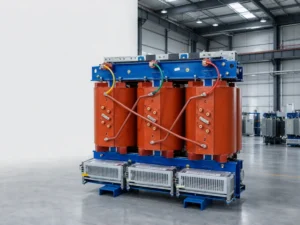
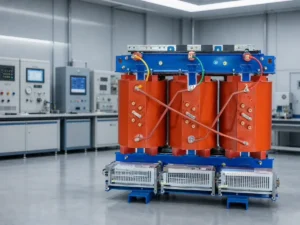
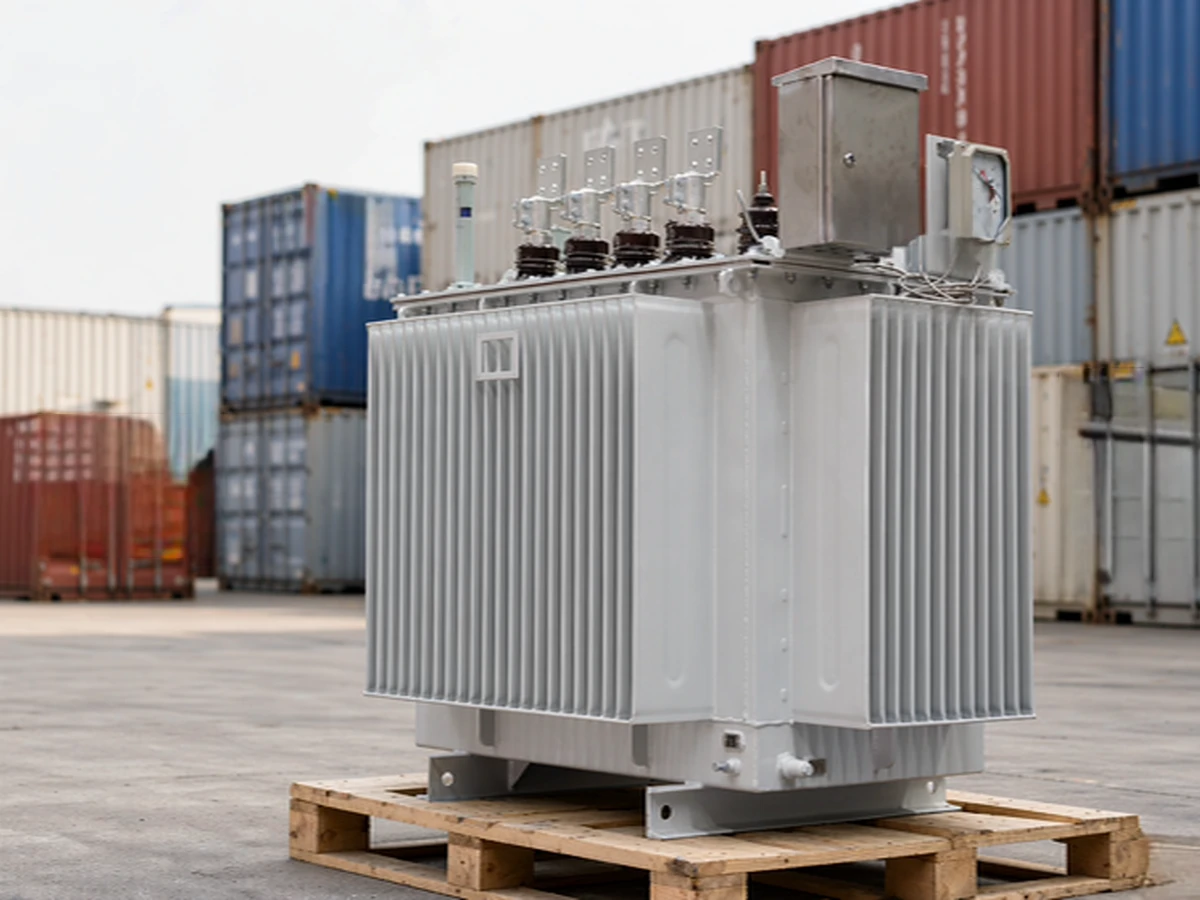
For buyers exporting to North America or Europe, the practical value of an experienced supplier is the ability to translate a local grid specification into a correct design — including the correct frequency, vector group, and test package — before manufacturing begins. The full transformer product catalog shows the main product families that can be configured for either standard. Whether the requirement calls for Trockentransformatoren for an indoor substation or Öltransformatoren for outdoor distribution, the same voltage-and-frequency discipline applies.
Schlussfolgerung
Exporting a transformer successfully comes down to respecting the grid it will serve. Transformer voltage standards 50Hz 60Hz are not interchangeable labels — they define core flux, losses, impedance, and temperature rise. North America’s 60 Hz, ANSI/IEEE-based system and Europe’s 50 Hz, IEC-based system differ in voltage classes, connection conventions, and certification layers. Confirm frequency, voltage, vector group, and the applicable standard at the start of every project, and record them in a single consolidated specification. Do that, and a transformer built on one continent will perform reliably on another. If you need help aligning a specification with your destination market, contact our engineering team to review the requirements before production.
Häufig gestellte Fragen
Can a 50 Hz transformer be used on a 60 Hz supply?
Often yes, after a design review. At 60 Hz the core flux is lower, so the unit usually runs cooler with reduced iron loss. The voltage ratio, impedance, and loss guarantees should still be checked at the new frequency.
Can a 60 Hz transformer be used on a 50 Hz supply?
Not at full rating in most cases. At 50 Hz the core flux rises by roughly 20%, which can cause saturation, higher magnetizing current, and overheating. Derating or a reduced V/f ratio is normally required.
What are the most common North American transformer voltages?
Common levels include 208Y/120 V and 480Y/277 V at low voltage, and 4.16 kV, 13.8 kV, and 34.5 kV at medium voltage, all at 60 Hz.
What are the most common European transformer voltages?
Low voltage is typically 230/400 V or 400/690 V, with medium-voltage levels of 10 kV, 11 kV, 20 kV, and 33 kV, all at 50 Hz.
What is a vector group and why does it matter for exports?
A vector group describes the winding connection and phase displacement between primary and secondary. It affects grounding, harmonics, and parallel operation. Dyn11 is common in Europe, while North American drawings often describe the connection directly.
Which standard applies to a transformer exported to Europe?
The IEC 60076 series is the primary standard, usually accompanied by EN or harmonized documents plus CE marking, ErP efficiency requirements, and RoHS/REACH compliance where applicable.
Which standard applies to a transformer exported to North America?
IEEE C57 and ANSI C84.1 govern design and voltage ratings, with UL or CSA listing frequently required and DOE efficiency rules applying to distribution transformers.
What information should I give a supplier for an export transformer?
Provide frequency, primary and secondary voltage, phase and connection, vector group, tap range, impedance, insulation class, cooling method, enclosure rating, and the required standard and certification package. Confirm all of these against the utility supply before ordering.
Ready to specify a transformer for export? Contact Daqo’s team with your voltage, frequency, and destination requirements for a configuration review.