If you specify, buy, or maintain transformers, understanding the transformer manufacturing process helps you judge whether a supplier can deliver a unit that will perform reliably for decades. A transformer looks simple from the outside — a tank, a core, a set of bushings — but its performance is decided by dozens of tightly controlled steps that most buyers never see. This guide walks through those steps, explains what each one controls, and shows how routine and type tests verify that the design intent survived production. Whether you are evaluating a transformador de tipo seco for a building or an oil-immersed unit for a substation, the same quality principles apply.
Conclusiones clave
- A transformer is only as good as its incoming materials — core steel, conductor, insulation and oil are checked before any cutting or winding begins.
- Core cutting and stacking control no-load loss and noise; winding tension, transposition and curing control load loss and short-circuit strength.
- Vacuum drying and impregnation remove moisture and air — the two main enemies of insulation life — before the unit is sealed or cast.
- Partial discharge testing is the most sensitive early-warning check for insulation voids and contamination.
- Routine tests are run on every unit; type tests are run on a representative design to prove performance under stress.
- Batch consistency comes from documented procedures, traceable materials and measured process control, not from final inspection alone.
The Transformer Manufacturing Process: An Overview
The transformer manufacturing process can be grouped into five stages: incoming material control, core fabrication, winding fabrication, assembly with drying and impregnation, and final testing. Each stage has its own checkpoints, and defects caught early are far cheaper to correct than defects found after the tank is sealed. A useful mental model is to follow the two paths that meet inside every transformer — the magnetic path (the core) and the electrical path (the windings and insulation) — and ask at each step what could go wrong in each path.
Process discipline matters more as ratings rise. A distribution unit and a large power transformer use the same basic operations, but the tolerance for contamination, moisture and mechanical movement shrinks as voltage and short-circuit duty increase. This is why manufacturers separate “routine” production from “type” and “special” verification, and why buyers of critical units often review the quality plan before ordering. Daqo Group draws on more than 30 years in the transformer industry, six production bases and four research institutes to standardize these steps across product lines — generic process capability that buyers can evaluate through documented performance and qualification records.
Step 1: Incoming Raw Material Control
Quality starts at the goods-in gate. The main material families are magnetic steel for the core, copper or aluminum for the windings, solid insulation (paper, pressboard, epoxy, Nomex-type aramid where specified), transformer oil for liquid-filled units, and tank/structural steel. Each family is checked against the purchase specification before release to production.
- Core steel: verified for grade, thickness, coating and losses. Grain-oriented silicon steel is supplied in coils and must be handled without bending or edge damage that would degrade the magnetic properties.
- Conductor: checked for cross-section, conductivity, temper and insulation coating. Copper and aluminum behave differently during winding and termination; the trade-offs are covered in our guide to copper vs aluminum windings and core materials.
- Solid insulation: checked for thickness, density, dielectric strength and moisture content. Insulation that has absorbed humidity can ruin an otherwise well-built unit.
- Oil: checked for dielectric strength, water content, acidity and dissolved gases before filling. For the functions and types of insulating oil, see our companion discussion of transformer oil.
- Tank and fittings: checked for material grade, welding quality and dimensional fit before assembly.
Correct storage is part of control. Core steel coils are kept dry and supported; insulation is stored in conditioned rooms; conductor is protected from oxidation and damage. A supplier that treats storage seriously is usually a supplier that treats the rest of the process seriously.
Step 2: Core Fabrication — Cutting, Stacking and Annealing
The core is the transformer’s magnetic circuit, and its fabrication largely determines no-load (excitation) loss and magnetizing current. Grain-oriented steel conducts flux best along the rolling direction, so laminations are cut at precise angles and stacked so the flux path follows the grain. Modern lines use computer-controlled cut-to-length machines and step-lap stacking to reduce joint reluctance, which lowers losses and audible noise.
After cutting, laminations may be stress-relief annealed to restore magnetic properties disturbed by shearing. During stacking, workers control the overlap of joints, the clamp pressure and the alignment of the limbs and yokes. A poorly stacked core has higher losses, higher magnetizing current and more vibration — the mechanical hum that operators often notice first. Core earthing is also established here, with a single, controlled earth point to prevent circulating currents.
Step 3: Winding Fabrication — Conductor, Tension and Transposition
If the core governs no-load loss, the windings govern load loss and the ability to survive a short circuit. Windings are formed on a winding machine around a former, with layer insulation, cooling ducts and end insulation placed as the design requires. Three parameters dominate quality:
- Tension control: the conductor must be wound tightly enough to resist movement under short-circuit forces, but not so tightly that insulation is damaged. Consistent tension is a hallmark of a controlled process.
- Transposition and stranding: in large units, parallel strands are transposed so each strand sees the same flux exposure, balancing current and limiting eddy-current losses.
- Insulation system integrity: turns, layers and the main insulation to the core and tank must be free of voids, creases and contamination. The arrangement of these materials is described in our article on the key components of a dry-type transformer, many of which are common to liquid-filled designs.
Leads, tap connections and terminations are then formed and brazed or welded. Every joint is a potential hot spot, so joint quality and insulation build-up are inspected. Winding resistance is often measured at this stage to confirm conductor continuity before the unit moves on.
Step 4: Assembly, Vacuum Drying and Impregnation
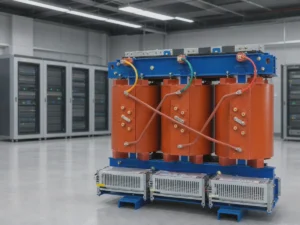
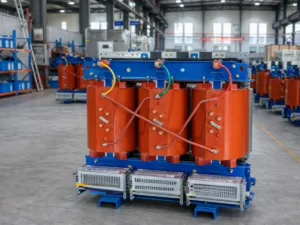
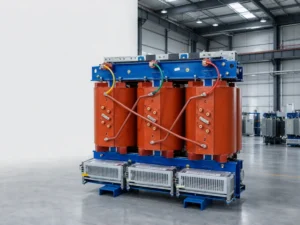
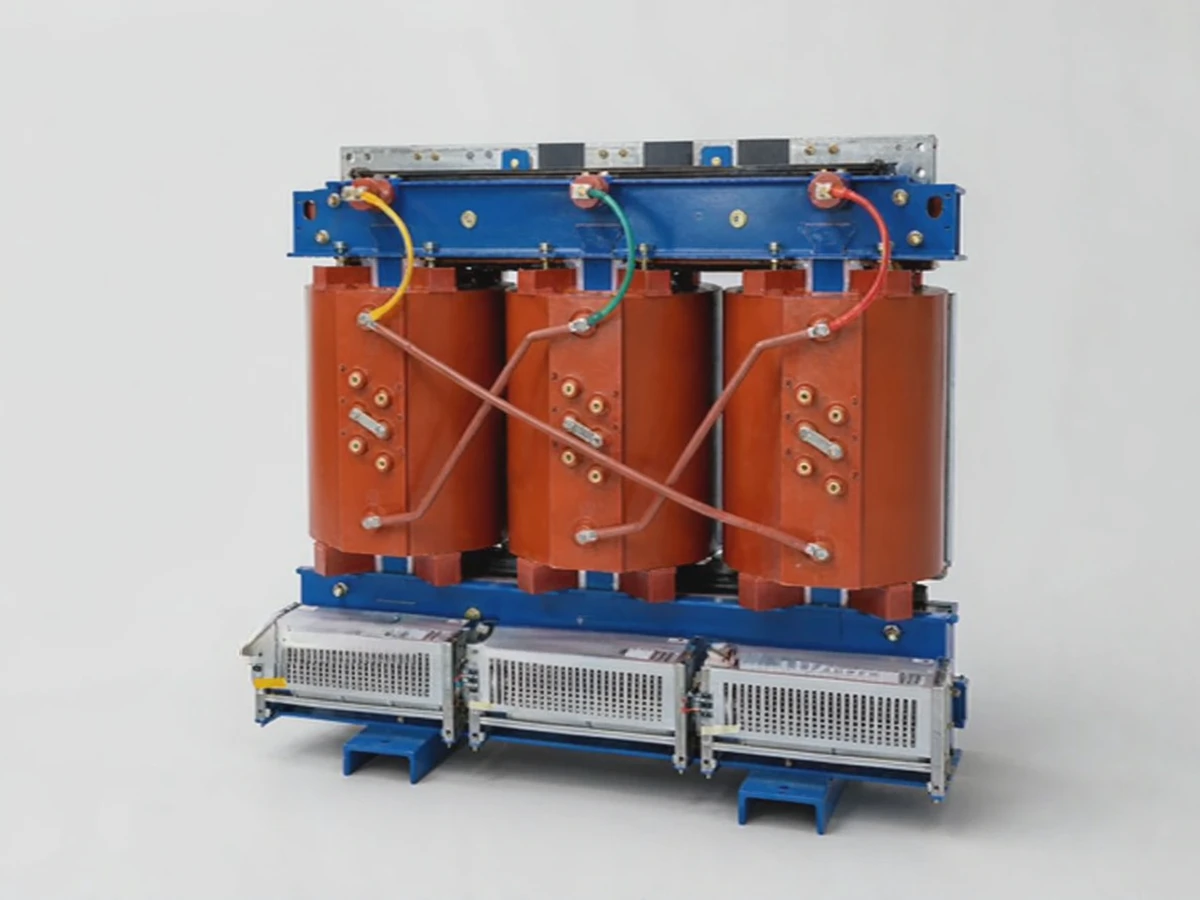
Core and windings are assembled with tank, leads, bushings, tap changer and cooling equipment. For liquid-immersed units the active part is lowered into the tank; for cast-resin dry-type units the windings are cast in epoxy under vacuum. In both cases moisture and trapped air are the principal risks, because water dramatically lowers breakdown strength and air voids allow partial discharge.
Vacuum drying heats the active part under vacuum to drive out moisture, followed by vacuum filling with oil or vacuum casting with resin. The sequence, temperature, vacuum level and duration are recorded for each unit. A well-controlled drying and filling process is one of the strongest predictors of long insulation life, and it is a key reason buyers audit the manufacturing process rather than relying on a nameplate alone.
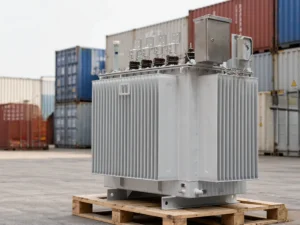
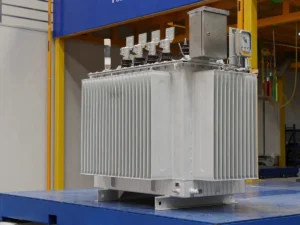
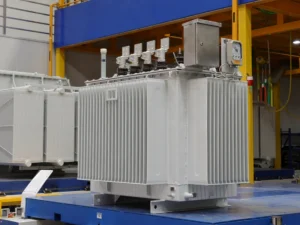
For liquid-filled transformers, oil is filled under vacuum and the tank is sealed with a conservator or sealed system. For dry-type cast-resin units, the curing cycle controls the mechanical and dielectric properties of the casting. Our overview of transformadores sumergidos en aceite explains how the tank and cooling system complete the design.
Step 5: Partial Discharge Control
Partial discharge (PD) is a localized electrical discharge that does not bridge the insulation but slowly erodes it. It is both a quality indicator and a failure mechanism. During manufacturing, PD is controlled by keeping insulation clean and dry, avoiding voids in casting and impregnation, and verifying the result with sensitive measurement. A low PD level at factory test is one of the best assurances that insulation will age slowly in service.
Buyers who want to understand the measurement method can read our detailed guide to partial discharge testing for dry-type transformers. The same physical principles apply to liquid-filled units, where PD can occur in paper insulation or at floating potentials.
Quality Control Along the Line
Modern factories increasingly use intelligent manufacturing methods — automated winding, robotic casting, in-process measurement and digital work instructions — to reduce variation. Automation is not a guarantee of quality by itself; the value comes from measuring critical parameters and reacting when they drift. Typical in-process checkpoints include:
- Lamination dimensions, stack height and joint gap during core build.
- Winding resistance, turns ratio and dimensional checks after winding.
- Moisture content and vacuum-cycle records before drying and filling.
- Oil dielectric strength and water content after filling.
- Torque checks on bushing and lead connections, and leak checks on sealed joints.
These records form the traceability trail that lets a manufacturer link any finished unit back to its material lots and process parameters. Traceability is what makes a warranty meaningful and what allows a supplier to investigate a field issue systematically.
Routine Tests, Type Tests and Special Tests
Testing is the final gate of the transformer manufacturing process, but not all tests serve the same purpose. Understanding the difference helps buyers specify correctly and avoid paying for unnecessary work — or skipping a test that matters.
| Test category | When performed | Typical examples | What it proves |
|---|---|---|---|
| Routine tests | Every finished unit | Winding resistance, ratio and vector group, insulation resistance, applied and induced voltage withstand, no-load loss and current, load loss and impedance voltage, oil dielectric strength | The unit meets its nameplate and passes basic dielectric and performance checks |
| Type tests | One representative unit of a design, or when design/material changes occur | Temperature rise, lightning impulse withstand, short-circuit withstand, sound level, dielectric tests at rated levels | The design itself meets the standard’s performance and stress requirements |
| Special tests | When the contract or specification calls for them | Partial discharge measurement, capacitance and tan delta, transferred surge, harmonic and zero-sequence tests, extended temperature rise | Additional properties needed for a specific application or risk profile |
Routine tests are non-negotiable: they confirm that the individual unit was built correctly. Type tests validate the design once and are repeated when something material changes. Special tests fill gaps for special duty. The applicable methods and limits are defined by standards — a topic we cover in our guide to transformer standards and certifications. Buyers should state in the purchase specification exactly which tests are required and whether they want to witness them.
Ensuring Batch Consistency
A single good transformer proves little; a hundred consistent transformers prove a process. Batch consistency comes from controlled materials, documented work instructions, calibrated equipment, trained operators and statistical review of test results. When no-load loss, load loss, impedance and ratio stay within tight bands across a production run, that is evidence the process is stable.
This is also where a supplier’s investment in people and systems becomes visible. Regular calibration of test benches, control of environmental conditions in winding and casting areas, and review of out-of-trend results all separate a mature operation from a workshop that relies on final inspection to catch mistakes. Consistency is easier to assess over multiple orders than within a single one, which is why reference lists and repeat business are useful signals.
How Material and Design Choices Shape the Process
Not all transformers are manufactured the same way. A cast-resin dry-type unit, an amorphous-core distribution transformer and a large oil-filled power transformer differ in process emphasis. Amorphous cores, for example, are thinner and more fragile than silicon steel and demand different cutting and handling. Copper windings require different termination techniques than aluminum. Efficiency-driven designs may use thicker insulation and more cooling ducts, which affect drying time. Understanding these links helps buyers ask better questions and evaluate quotations on more than price.
Ultimately, the manufacturing process is where a design becomes a product, and quality control is the discipline that keeps that translation faithful. The most reliable suppliers are those that can explain not only what they test, but how they control the steps that determine the result before testing begins.
What Buyers Should Ask a Manufacturer
Before placing an order, ask to see the quality plan, the list of routine and type tests, the material traceability approach, and records of recent production. Ask how partial discharge is controlled and measured, how drying and filling are verified, and how out-of-trend test results are handled. A supplier that answers these questions with documents and data is demonstrating the same discipline the factory applies on the floor. If you would like to discuss a specific specification or arrange a technical review, you can Contacta con nuestro equipo de ingeniería..
Conclusión
The transformer manufacturing process is a chain of interdependent steps: material control, core fabrication, winding, drying and impregnation, and layered testing. No single inspection at the end can compensate for weak control earlier. For buyers, the practical lesson is to evaluate the process, not just the product — ask about incoming material checks, in-process measurement, partial discharge control, and the distinction between routine and type tests. A transparent, well-documented process is the strongest predictor that a transformer will deliver its rated performance for decades. Use this framework the next time you compare quotations, and you will see differences that a price sheet alone never reveals.
Preguntas frecuentes
What are the main stages of the transformer manufacturing process?
The five main stages are incoming raw material control, core fabrication, winding fabrication, assembly with vacuum drying and impregnation, and final testing. Each stage has checkpoints that catch defects before they become expensive to fix.
Which tests are performed on every transformer?
Routine tests are performed on every unit and typically include winding resistance, voltage ratio and vector group, insulation resistance, applied and induced voltage withstand, no-load loss and current, load loss and impedance voltage, and oil dielectric strength for liquid-filled units.
What is the difference between a routine test and a type test?
Routine tests verify that each individual unit was built correctly. Type tests validate the design itself on one representative unit, covering stress conditions such as temperature rise, lightning impulse and short-circuit withstand. Special tests are added when a contract requires them.
Why is vacuum drying important in transformer manufacturing?
Moisture sharply reduces the dielectric strength of insulation and accelerates aging. Vacuum drying removes water from the core and windings before oil filling or resin casting, which is essential for long insulation life.
What does a partial discharge test reveal?
Partial discharge testing detects small, localized electrical discharges inside insulation. A low PD level indicates a well-impregnated, void-free insulation system and is a strong predictor of reliable long-term performance.
How do manufacturers ensure consistency between units?
Consistency comes from controlled materials, documented work instructions, calibrated equipment, in-process measurement and statistical review of test results — not from final inspection alone. Traceability links each unit to its material lots and process records.
Do dry-type and oil-immersed transformers use the same manufacturing process?
They share core and winding fabrication, but differ in the final stages. Dry-type cast-resin units are vacuum-cast and cured, while oil-immersed units are dried, vacuum-filled with oil and sealed. Both depend on the same principles of moisture and void control.
What should I ask a supplier before ordering?
Ask for the quality plan, the exact list of routine, type and special tests, material traceability records, and evidence of process control such as loss and impedance trends across recent production. Clarify whether you want to witness any tests.