Learning how to size a transformer is less about picking a bigger number and more about understanding the load you actually have. An oversized unit wastes money and runs inefficiently at light load; an undersized unit overheats, ages quickly, and trips protection at the worst possible moment. A sound sizing exercise balances connected load, demand and diversity, harmonics, future growth, and the economic cost of losses over the life of the asset. This guide walks through a practical method, with the reasoning you need to defend each assumption. If you want the deeper theory on matching load to equipment, our article on selecting transformers by load characteristics is a useful companion.
Points clés à retenir
- Size from measured or realistically estimated demand, not from the sum of connected nameplate ratings.
- Demand factor, diversity factor, and load factor describe how the load behaves and prevent gross oversizing.
- Non-linear loads create harmonics that raise winding and neutral heating; a K-factor or derating approach may be required.
- No-load losses occur whenever the transformer is energized, while load losses scale with current squared.
- The economically optimal loading point balances capital cost against the present value of losses over the asset life.
- Leave reasonable room for growth, but avoid large margins that push the unit into a light-load, low-efficiency region.
Start With the Load: Characteristics and Profile
Every sizing decision begins with the load. Two facilities with the same connected kVA can need very different transformers depending on how that load behaves over time. Before doing arithmetic, describe the load profile.
Continuous, Intermittent, and Fluctuating Loads
A continuous load runs near a steady level for long hours, such as a process plant or a data hall. A transformer serving it should be rated close to that sustained demand. An intermittent load, such as a crane or a welding station, draws high current in short bursts with rest periods; the thermal time constant of the transformer lets it absorb brief peaks, so a smaller unit may suffice. A fluctuating load varies through the day with peaks and valleys, and the key question becomes how high the peaks are and how long they last.
Load profile matters because the transformer’s insulation ages according to temperature over time. A few short peaks are far less damaging than a high average load held for months. This is why two loads with the same maximum kVA can justify different ratings, and why a logger or a verified load study is worth far more than a guess.
Linear and Non-Linear Loads
A linear load draws current roughly proportional to voltage, with a near-sinusoidal waveform — heating elements and motors are close approximations. A non-linear load draws current in pulses, typical of variable-speed drives, rectifiers, switch-mode power supplies, UPS systems, and LED lighting. Non-linear loads inject harmonics into the current waveform, which adds heating that a simple kVA calculation misses. We return to this below.
| Load characteristic | What to measure | Effect on sizing |
|---|---|---|
| Steady continuous | Average kVA over operating hours | Rating close to sustained demand; good efficiency focus |
| Short, intermittent peaks | Peak kVA and duty cycle | Thermal inertia allows a smaller rating |
| Highly fluctuating | Peak duration and load factor | Rating driven by sustained peaks, not momentary spikes |
| Non-linear / harmonic | THD, K-factor, neutral current | Derating or a special winding design may be needed |
| Growing | Planned expansion and timing | Add staged margin rather than a single large step |
Demand Factor, Diversity, and Load Factor
Three related ratios turn a list of connected equipment into a realistic demand estimate. Confusing them is the fastest route to an oversized transformer.
- Demand factor is the maximum demand of a system divided by the total connected load. A workshop with 1000 kVA of connected motors that never draws more than 600 kVA has a demand factor of 0.6.
- Diversity factor is the sum of individual maximum demands divided by the maximum demand of the whole system. Because not all loads peak at once, this value is greater than 1.
- Load factor is the average load divided by the peak load over a period. A high load factor means the transformer is used steadily and is usually more economical to serve.
A worked example makes the chain clear. Suppose a facility has 800 kVA of connected load, a demand factor of 0.7, and diversity among subgroups of 1.1. The estimated maximum demand is 800 × 0.7 = 560 kVA, adjusted by diversity as appropriate for the grouping. If harmonic content and a modest 15% growth margin are then applied, the target rating moves toward roughly 650–700 kVA, at which point you would select the next standard size up. The exact margin depends on how certain the load data is and how quickly the site is expected to grow. The paramètres de sélection du transformateur guide shows how the resulting requirement is translated into a rated nameplate.
How to Size a Transformer: A Step-by-Step Method
With the load characterized, a reliable sizing process follows a repeatable sequence.
- List the connected load. Record the kVA (not just kW) of every significant load, including motors at starting duty and future equipment that is already committed.
- Apply demand and diversity. Reduce connected load to realistic maximum demand using measured or industry-typical factors.
- Account for harmonics. If non-linear loads are significant, estimate K-factor or THD and apply the appropriate derating.
- Add growth margin. Include a sensible allowance for expansion, preferably in stages aligned with a building or process plan.
- Select a standard rating. Round up to the nearest standard kVA that comfortably covers the adjusted demand.
- Check voltage drop and fault level. Confirm the impedance gives acceptable regulation and that fault currents stay within equipment ratings.
- Verify thermally. Confirm the chosen unit’s temperature rise and cooling class suit the ambient and duty cycle.
- Review economics. Compare candidates on total cost, including losses, not just purchase price.
Each step should be documented, because the assumptions are what a reviewer will question. A transformer that is correctly sized on paper but built with the wrong winding material can still run hot; the trade-offs between copper and aluminum conductors are explained in our copper vs aluminum transformer guide.
Harmonics and Non-Linear Loads
Harmonics are currents or voltages at integer multiples of the fundamental frequency. In a facility full of drives, rectifiers, and switch-mode supplies, the current waveform is distorted, and that distortion has three practical consequences for sizing.
First, harmonic currents increase the RMS current in the windings, raising copper loss beyond what the fundamental kVA suggests. Second, eddy-current losses in the windings and stray losses in structural parts rise rapidly with frequency, so heating grows faster than the simple RMS figure implies. Third, in three-phase four-wire systems, triplen harmonics from single-phase non-linear loads add in the neutral rather than cancelling, which can overload a neutral sized only for fundamental current.
Engineers commonly respond in one of three ways: apply a conservative derating to the transformer’s nameplate kVA; specify a transformer with a stated K-factor rating that quantifies its ability to serve harmonic-rich loads without exceeding temperature limits; or use a design with features that better tolerate harmonics, such as a delta winding that provides a circulating path for triplen currents. The relevant assessment methods are described in standards such as IEEE C57.110, and the right choice depends on measured THD and the mix of loads. When in doubt, measure the current waveform at the main incomer before fixing the rating. Critical-power environments such as data centers have especially high harmonic content, which is why our data center transformer guide treats harmonics and redundancy together.
Economic Loading and the Cost of Losses
Purchase price is only part of what a transformer costs over its life. Because a transformer is energized for thousands of hours each year, the cost of losses can equal or exceed the initial capital outlay. Economic loading means choosing a rating and operating point that minimize the sum of capital and loss costs.
No-Load and Load Losses
No-load losses (iron losses) occur whenever the transformer is energized, regardless of output. They are driven by the core material and design. Load losses (copper losses) vary with the square of the load current. At light load, no-load losses dominate; near full load, copper losses dominate. The efficiency curve therefore peaks at an intermediate loading level, often around 40–60% of rating for many distribution designs, though the exact point depends on the ratio of the two loss types.
This is why a heavily oversized transformer is inefficient: it sits in a region where constant no-load losses are large relative to the small load it serves. It is also why running a unit consistently near its thermal limit is unattractive: copper loss rises with the square of current and accelerates insulation aging. Economic loading finds the middle ground.
Comparing Candidates on Total Cost
A practical comparison assigns a monetary value to losses using an agreed energy price, load profile, and evaluation period, then adds the purchase price. A slightly more expensive unit with lower losses can win comfortably over a lifetime, especially where energy costs are high or the transformer runs continuously. This evaluation is also where premium core materials become attractive, as discussed in the materials section of this guide. If your project has a specific efficiency target, ask the supplier for loss figures at the relevant loading points rather than relying on a single nameplate efficiency value.
Dry-Type or Oil-Immersed for Your Load?
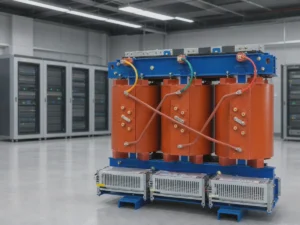
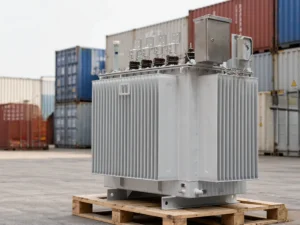
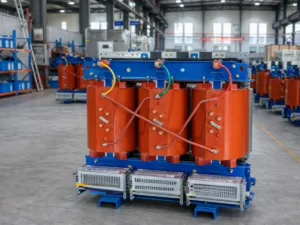
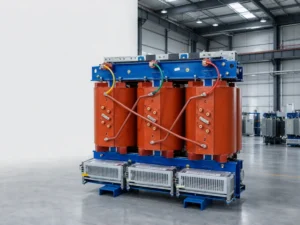
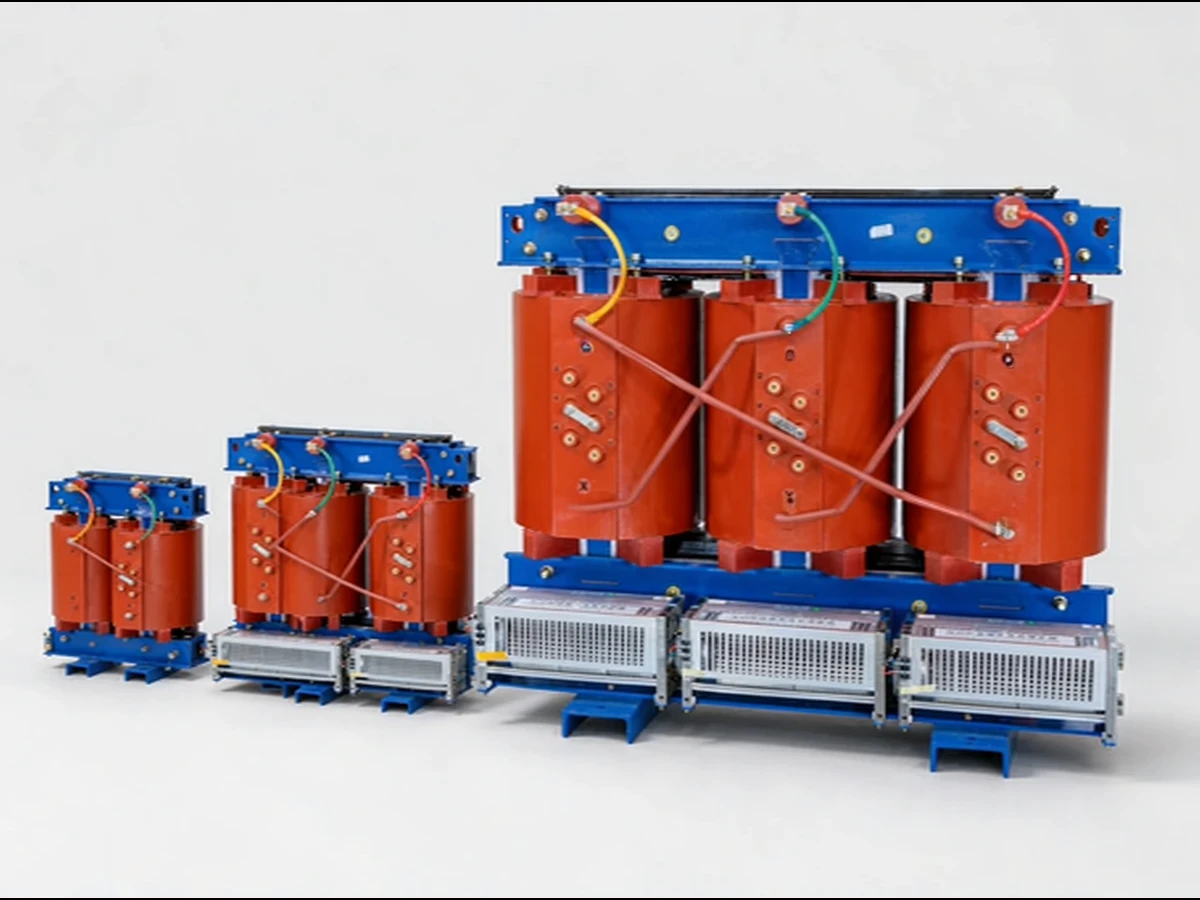
Sizing does not end at kVA; the cooling medium affects what the rating means in practice. Transformateurs à sec are commonly chosen for indoor installations, fire-sensitive buildings, and locations where oil containment is undesirable. Their ratings depend heavily on ventilation and ambient temperature, and their cooling classes (AN, AF) describe how air removes heat. Transformateurs immergés dans l'huile generally offer better heat transfer and are common outdoors and in substations, with oil circulation and radiators carrying heat away. A fluid-filled unit’s ability to shed heat also depends on the oil and radiator design, so the two decisions should be made together.
Whichever family you choose, verify that the stated rating applies to your actual ambient, altitude, and ventilation. A nameplate kVA is valid only under the reference conditions assumed by its cooling class; a hot room or a high altitude can require derating. The nameplate values themselves are decoded in our nameplate parameters guide.
Common Sizing Mistakes to Avoid
- Sizing from connected load alone. Ignoring demand and diversity leads to a unit several times larger than necessary.
- Forgetting harmonics. A drive-heavy load can overheat a transformer that looks adequate on kVA alone.
- Ignoring growth until it is too late. A planned expansion should be built into the rating or the replacement schedule.
- Over-sizing for safety. Excessive margin raises cost and pushes operation into a low-efficiency region.
- Neglecting voltage drop and fault level. Impedance affects both regulation and the fault current the switchgear must withstand.
- Applying nameplate ratings to the wrong conditions. High ambient temperature, altitude, or poor ventilation reduce real capacity.
Daqo Group co., Ltd. is a professional transformer manufacturer with more than 30 years in the industry, 2000+ global customers, 40+ countries, 6 production bases, and 4 research institutes, supplying dry-type, oil-immersed, and padmount products to IEEE/IEC/ANSI standards. Confirm the available kVA ratings, harmonic-duty designs and loss data for your specific duty before finalizing a selection. Our team can review a load schedule and advise on the most suitable family within the product range.
Conclusion
Knowing how to size a transformer means translating a messy real-world load into a single defensible rating. Start with measured demand, apply demand, diversity, and load factors honestly, account for harmonics, add staged growth margin, and then test the candidates for voltage drop, fault level, thermal suitability, and lifetime cost. Resist the temptation to oversize “just in case” — a right-sized transformer costs less to buy and less to run. To have a load schedule reviewed or to discuss a specific duty, contact the team through the page de contact.
Foire aux questions
What is the difference between demand factor and diversity factor?
Demand factor compares a system’s maximum demand to its total connected load. Diversity factor compares the sum of individual maximum demands to the maximum demand of the whole system, reflecting that loads do not all peak at once.
Why can an undersized transformer fail even if average load is low?
Because heating depends on current squared and on sustained peaks, not just the average. Repeated high peaks or harmonic-rich currents can push winding temperature beyond insulation limits even when the average kVA looks modest.
Do harmonics require a larger transformer?
Often yes. Harmonic currents increase RMS current and high-frequency winding losses, so a transformer serving many non-linear loads may need derating or a unit with a suitable K-factor rating.
How much margin should I add for future growth?
It depends on how certain your expansion plans are. A staged approach — selecting a rating that covers committed growth and planning a future unit for later phases — is usually more economical than a single large upfront margin.
Is the most efficient transformer always the best buy?
Not always. The best choice balances purchase price against the present value of losses over the operating life and load profile. A unit with low losses can be worth a premium where energy is expensive or the transformer runs continuously.
Does altitude or high ambient temperature affect transformer sizing?
Yes. Thinner air at altitude and higher ambient temperatures reduce cooling effectiveness, so a transformer may need derating relative to its nameplate rating under those conditions.
Should I size a transformer in kW or kVA?
Always in kVA. Transformers are limited by voltage and current, not by real power, because their losses depend on current and voltage rather than load power factor.