
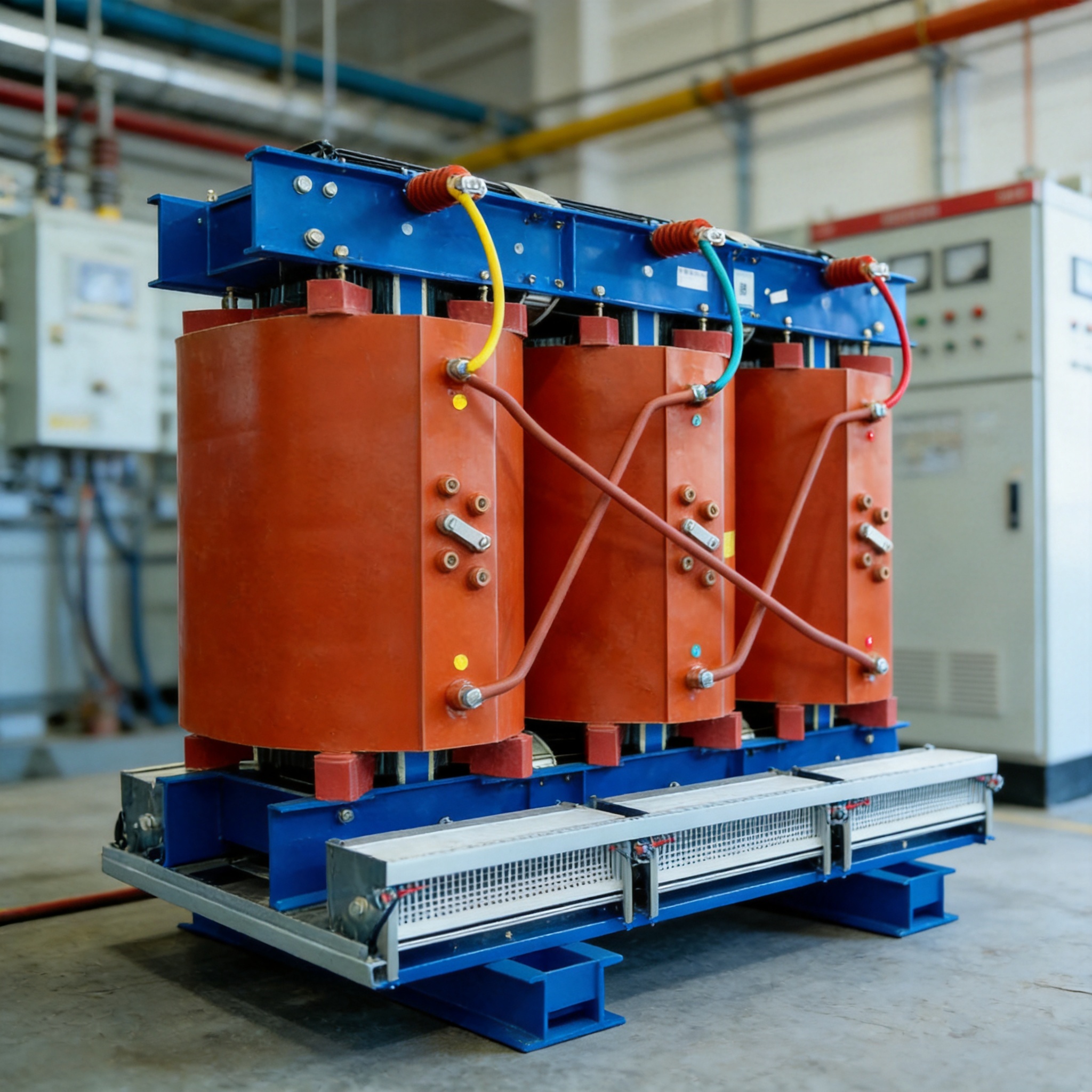
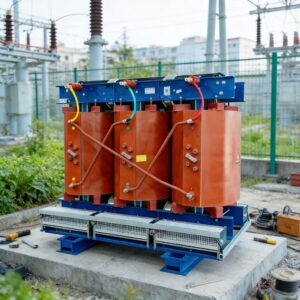
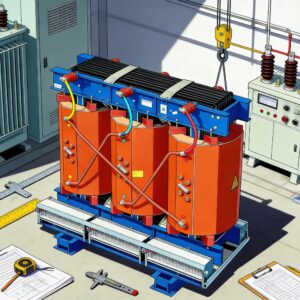
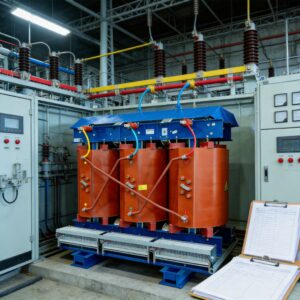
Dry-type transformer maintenance is the scheduled inspection, cleaning, and insulation resistance (IR) testing of an air-cooled transformer to prevent winding failures, flashovers, and unplanned downtime. For a typical SCB unit (30–5000 kVA, insulation class F or H, impedance 4–10%), a complete maintenance cycle takes 2–4 hours and requires only basic tools plus a 1000 V or 2500 V megohmmeter. After reading this guide, you will be able to inspect your transformer, clean it without damaging the windings, run an IR test, and decide from the reading whether the unit can stay in service.
Table des matières
Why Dry-Type Transformers Need Maintenance
A dry-type transformer has no oil to carry heat away or to insulate the windings. Instead, it relies on air circulation and solid insulation — typically cast resin or vacuum-pressure-impregnated windings rated class F (155 °C) or H (180 °C). That insulation degrades from three things: dust buildup, moisture, and partial discharge. Dust blocks cooling ducts and lets heat accumulate; moisture lowers surface resistance; partial discharge slowly erodes the resin until a flashover occurs.
The maintenance interval follows the environment, not the calendar alone. Use this decision rule:
- Clean, climate-controlled room: inspect every 12 months, IR test every 24 months.
- Dusty or humid room, or near a loading dock: inspect every 6 months, IR test every 12 months.
- After any event — water leak, rodent intrusion, tripped protection, or a nearby fault — inspect and IR test immediately, regardless of schedule.
Standards such as IEC 60076-11 (dry-type transformers) define the thermal and insulation requirements these checks protect. Your maintenance goal is simple: keep the insulation resistance high and the cooling paths open so the winding never exceeds its class limit.
Step-by-Step: Regular Inspection
Do the inspection first, before you touch anything with a cloth or a meter. Work through these steps in order and record every finding.
- De-energize and lock out. Open the upstream breaker, apply a lockout tag, and verify zero voltage at the primary and secondary terminals with a rated voltage detector.
- Let the unit cool. Wait until the winding surface is below 40 °C before touching it. A unit that ran at class F temperature can stay hot for over an hour.
- Check the enclosure and room. Look for water stains, rust, broken louvers, or blocked ventilation openings. Air must enter low and exit high for natural convection to work.
- Inspect the windings visually. Look for dust tracks, dark spots, cracks in the cast resin, or a white/grey powder (tracking marks). Photograph anything suspicious.
- Check connections and terminals. Look for discoloration, melted insulation, or loose hardware. A discolored terminal indicates a loose joint that has been overheating.
- Verify the temperature sensors and fans. Confirm the winding temperature display reads ambient when cold, and that cooling fans spin freely by hand.
- Check the tap link. Confirm the tap position matches the as-built record. A tap changed during a voltage problem and never restored is a common find.
- Record all readings. Log ambient temperature, humidity, and every observation. This baseline is what makes the next inspection meaningful.
For a 10 kV SCB unit, also inspect the lightning impulse (LI75) and AC withstand (AC35) rated bushings for chips or contamination. Any crack in a bushing is a replacement item, not a repair item.
Step-by-Step: Cleaning the Windings and Core
Cleaning restores the cooling path and removes the moisture-absorbing dust layer. Never use water, solvents, or a wire brush on cast resin — you will scratch the surface and create a tracking path.
- Confirm the unit is de-energized and cool (below 40 °C), per the inspection steps above.
- Vacuum first. Use a vacuum with a soft brush attachment on low suction. Work top to bottom so dust does not fall into clean ducts.
- Clean the cooling ducts. Pass a soft brush or low-pressure dry air (below 2 bar) through each vertical duct. Blocked ducts are the single most common cause of hot spots.
- Wipe the winding surfaces. Use a dry, lint-free cloth. For stubborn dust, use a cloth barely dampened with isopropyl alcohol, then wipe dry immediately.
- Clean the core and clamps. Remove dust from the core laminations and clamping structure. Check that the core is solidly grounded.
- Clean bushings and insulators. Wipe with a dry lint-free cloth. Do not use abrasive pads.
- Clean the enclosure interior. Vacuum the floor and ledges of the enclosure. Debris on the floor gets drawn into the windings by convection.
- Inspect again after cleaning. Cleaning often reveals cracks or tracking marks that dust was hiding. Re-check every winding surface.
- Restore and re-energize only after the IR test passes. Cleaning can introduce moisture, so always test before returning the unit to service.
Step-by-Step: Insulation Resistance Testing
The IR test measures how well the winding insulation resists current. You apply a DC voltage between a winding and ground and read the resistance in megohms (MΩ). For a 10 kV class SCB transformer, use a 2500 V megohmmeter; for units rated 1 kV and below, use 1000 V. A 1-minute reading is the standard test; the 10-minute reading gives the polarization index (PI).
- Isolate the transformer completely. Open and lock out all breakers. Disconnect the incoming cables if they share a ground path with other equipment.
- Ground and discharge the windings for at least 5 minutes before testing to remove any stored charge.
- Disconnect surge arresters and any electronic sensors. They will distort the reading or be damaged by test voltage.
- Connect the megohmmeter. Connect the LINE lead to the winding under test (start with high voltage to ground) and the EARTH lead to the transformer ground. Connect the GUARD lead to the bushing surface if surface leakage is suspected.
- Apply test voltage for 60 seconds. Start the timer when you apply voltage. Record the reading at exactly 60 seconds. Keep the leads still — movement causes noise.
- Test each winding to ground. Test high voltage to ground, then low voltage to ground. Record both.
- Discharge after every test. Ground the winding for at least 4 times the test duration before moving leads.
- Calculate PI if the reading is marginal. Run a 10-minute test and divide the 10-minute reading by the 1-minute reading. A PI above 2.0 is healthy; below 1.5 indicates moisture or aging.
- Compare to the baseline. A reading above 1000 MΩ is generally acceptable for a dry-type unit. The trend matters more than the absolute number: a drop to 20% of the previous value means investigate, even if the number still looks high.
Use this table to interpret results:
| 1-minute IR reading | Interprétation | Action |
|---|---|---|
| Above 1000 MΩ | Healthy insulation | Return to service |
| 100–1000 MΩ | Acceptable but monitor | Re-test in 3 months; check for moisture |
| Below 100 MΩ | Moisture or contamination likely | Dry out and clean, then re-test |
| Below 10 MΩ | Insulation failure risk | Do not energize; consult a qualified professional |
Temperature matters: IR roughly halves for every 10 °C rise. Always record winding temperature with the reading so the next test is comparable. For units rated 20 kV (LI125 AC50) or 35 kV (LI170 AC70), use a 5000 V megohmmeter and follow the manufacturer’s test procedure.
Erreurs courantes et comment les corriger
1. Testing while the transformer is still hot. Symptom: the IR reading looks low and you conclude the insulation is bad. Fix: let the unit cool to near ambient, record the temperature, and re-test. Compare readings only at similar temperatures.
2. Cleaning with water or a wet cloth. Symptom: IR drops sharply after cleaning, or tracking marks appear on the resin. Fix: use only dry methods or a cloth barely dampened with isopropyl alcohol, wipe dry immediately, and re-test. If moisture entered, dry the windings before energizing.
3. Skipping the discharge step. Symptom: a shock when you touch the leads, or a false reading on the next test. Fix: after every IR test, ground the winding for at least 4 times the test duration before moving any lead.
4. Ignoring a downward trend because the number is still “high.” Symptom: a unit that read 3000 MΩ two years ago now reads 600 MΩ and fails six months later. Fix: log every reading with temperature, and treat a 20% year-over-year drop as a trigger for investigation.
5. Cleaning the windings but not the cooling ducts. Symptom: the transformer runs hot despite looking clean. Fix: pass a brush or dry air through every duct. Visible cleanliness on the outer surface does not mean the ducts are open.
FAQ
How often should I test insulation resistance on a dry-type transformer? Every 12 months in dusty or humid rooms, every 24 months in clean climate-controlled rooms, and immediately after any water leak, fault, or protection trip.
What megohmmeter voltage should I use? 1000 V for units rated 1 kV and below, 2500 V for 10 kV class units, and 5000 V for 20 kV and 35 kV class units. Never apply a test voltage above the winding’s rated insulation level.
What is a good insulation resistance reading? Above 1000 MΩ is healthy for a dry-type transformer. Between 100 and 1000 MΩ is acceptable but should be monitored. Below 100 MΩ indicates moisture or contamination and requires drying and cleaning before re-testing.
Can I clean a dry-type transformer without de-energizing it? No. Always de-energize, lock out, verify zero voltage, and let the unit cool below 40 °C before cleaning or testing.
What does the polarization index tell me that the 1-minute reading does not? The PI (10-minute reading divided by 1-minute reading) reveals moisture and aging that a single reading can miss. Above 2.0 is healthy; below 1.5 means moisture or degraded insulation.
For the underlying insulation and thermal requirements your checks protect, refer to the IEC 60076 series published by the Commission électrotechnique internationale, and follow your transformer’s nameplate ratings (for SCB units: class F or H, impedance 4–10%, connection group Dyn11 or Yyn0).

 English
 Français
 Español
 Deutsch