

The core of our industrial setup is the industrial transformer. Essentially a passive component in a very complex industrial environment, the transformer makes it possible for electricity to supply a wide variety of industries and institutions. Even today, when energy efficiency has become a practical reality rather than just a concept, a wide range of industrial transformers is designed to meet the power demands of industrial and institutional applications.
In the previous section, we outlined the fundamentals of industrial power distribution systems and touched upon the role of industrial transformers in improving power distribution efficiency by transferring electricity from one part of a system to another. When dealing with the often complex systems found in industry, operators, designers, and buyers must understand the many types of transformers used across industries worldwide.
It is equally important to understand the applications of these power distribution components and the criteria that should be considered when selecting the proper unit for specific power distribution needs. With this knowledge, one can better understand the vital role that industrial transformers play in modern industrial power distribution systems.

The Fundamentals of Industrial Transformers
An industrial transformer is a stationary electrical machine used to transfer electrical power in the form of alternating current (AC) from one or more electrical conductors to one or more other electrical conductors.
The industrial transformer transfers power through electromagnetic induction, as described by Faraday’s Law of Electromagnetic Induction. A changing magnetic flux within a closed loop of wire (a coil) induces a voltage within another nearby loop of wire. Therefore, an industrial transformer can be used to “step up” (increase) AC voltage or “step down” (decrease) AC voltage. The transmission or operating voltage of an industrial transformer is selected according to the requirements of the industrial power application.
The core of an industrial transformer is typically made from laminated steel to guide the magnetic flux efficiently. The primary and secondary windings consist of two or more insulated conductors, usually copper or aluminum. These conductors are often arranged in layers of turns and positioned on opposite sides of the core.
Several types of losses occur within industrial transformers:
- Hysteresis losses in the core
- Eddy current losses in the core
- I²R (resistive) losses in the primary and secondary windings
All of these losses must be minimized to achieve high transformer efficiency.
Cooling and Protection Systems
Industrial power distribution transformers are typically high-power units that require reliable insulation systems. They also require provisions for cooling the windings and integrating protective devices.
Oil-Immersed Transformers
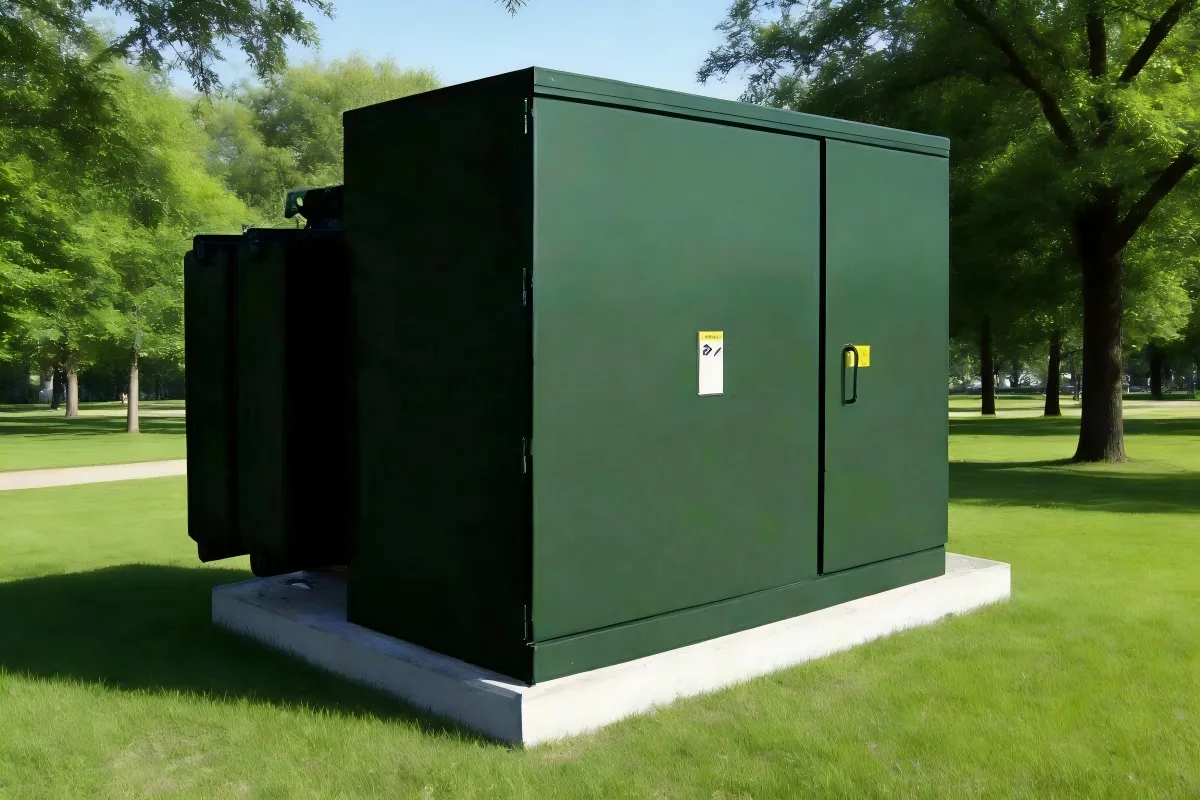
Oil-immersed transformers contain mineral oil that serves both as a coolant and a dielectric medium. Pumps circulate the oil, allowing it to cool the windings through convection and conduction. Due to potential fire hazards, oil-immersed transformers are commonly installed in outdoor transformer rooms.
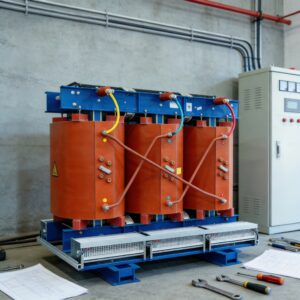
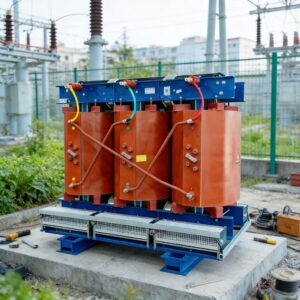
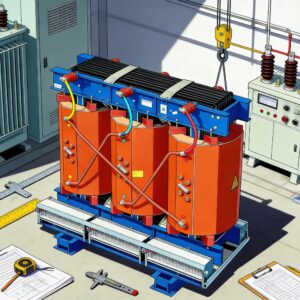
Dry-Type Transformers
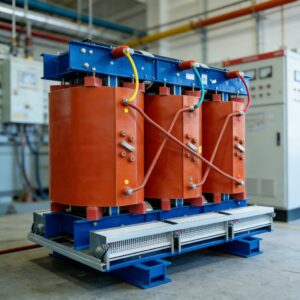
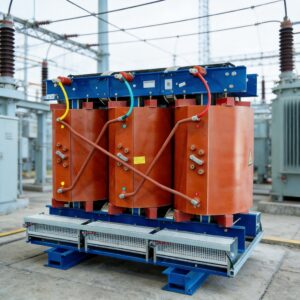
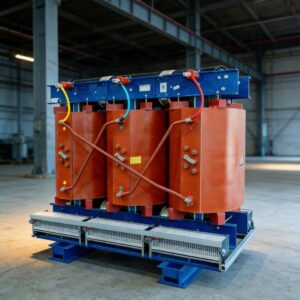
Dry-type transformers are generally installed indoors in electrical rooms or closets. They use air or epoxy resin as the insulating medium.
Additional components may include:
- Voltage regulators
- Tap changers
- Surge arresters
These devices help maintain stable output voltage and improve system protection.
The design of an industrial transformer must also prioritize reliability and maintainability, as failures in heavy industrial processes can result in high operational costs.
Types of Industrial Transformers
Step-Up Transformers
Step-up transformers are commonly used at generating stations to increase the voltage of generated electricity to transmission levels.
By increasing voltage, the transmission current decreases, reducing energy losses during long-distance power transmission.
Step-Down Transformers
Step-down transformers reduce transmission voltages to lower distribution voltages suitable for:
- Industrial machinery
- Lighting systems
- Control equipment
These transformers form a critical part of industrial power distribution networks.
Isolation Transformers
Isolation transformers provide galvanic isolation between input and output circuits, eliminating ground loops and improving electrical safety.
They are widely used for:
- Electrical testing
- Circuit troubleshooting
- Sensitive electronic equipment
Autotransformers
An autotransformer uses a single winding rather than separate primary and secondary windings.
Advantages include:
- Compact size
- Lower cost
- High efficiency
- Adjustable voltage ratios
Autotransformers are particularly useful when large voltage adjustments are required within a relatively small voltage range.
Instrument Transformers
Instrument transformers include:
Current Transformers (CTs)
Current transformers accurately measure high currents for monitoring and protection systems.
Potential Transformers (PTs)
Potential transformers accurately measure voltage levels and provide inputs for protection relays and metering equipment.
Specialized Industrial Transformers
Certain industries require specialized transformers capable of handling extremely high power levels.
Examples include:
Furnace Transformers
Used in electric arc furnaces to provide the massive currents required for metal melting and refining.
Rectifier Transformers
Used to supply DC power for industrial processes requiring high-current direct current systems.
When selecting an industrial transformer, several factors must be considered:
- Primary-to-secondary voltage ratio
- Load characteristics
- Expected duty cycle
- Environmental conditions
- Reliability requirements
Applications in Heavy Industries
Steel Industry
Industrial transformers play a critical role in steel production.
Their primary function is supplying the enormous currents required by electric arc furnaces used for melting and processing steel.
Precise voltage control is essential for:
- Production efficiency
- Product consistency
- Steel quality
Petroleum Refineries
In petroleum refineries, industrial transformers power:
- Compressors
- Pumps
- Distillation units
These transformers must accommodate fluctuating loads while protecting sensitive equipment from voltage disturbances.
Mining Industry
Mining operations often require transformers in remote and harsh environments.
Industrial transformers supply power to:
- Drilling equipment
- Crushers
- Conveyor systems
Because mining environments can be dusty, wet, hot, or extremely cold, transformers must withstand demanding operating conditions.
Dry-type outdoor transformers are frequently used because they require minimal maintenance while operating reliably in adverse conditions.
In many mining applications, transformers step down transmission voltages to levels suitable for local equipment and facilities.
Data Centers
Industrial-grade transformers are also widely used in data centers.
Common applications include:
- Isolation transformers
- UPS system transformers
- Power conditioning systems
These transformers support the reliable operation of critical digital infrastructure.
Future Trends and Innovations in Industrial Transformers
The industrial transformer market is evolving to meet growing global energy demands and increasing efficiency requirements.
Advanced Core Materials
Researchers continue to investigate new core materials, including:
- Nanocrystalline alloys
- Amorphous metal alloys
These materials offer:
- Lower hysteresis losses
- Improved efficiency
- Better performance at partial loads
The growing adoption of renewable energy systems and variable frequency drives (VFDs) is also driving transformer innovation.
Smart Transformers
Smart transformers equipped with sensors and IoT connectivity are becoming increasingly common.
These systems monitor:
- Temperature
- Vibration
- Oil condition
Real-time monitoring enables predictive maintenance and helps prevent unexpected failures.
Digital Twin Technology
Digital twin technology creates virtual models of physical transformers.
Benefits include:
- Load simulation
- Asset management optimization
- Improved maintenance planning
- Enhanced operational efficiency
Advanced Cooling Technologies
New cooling methods are also emerging, including:
- Liquid cooling
- Cryogenic cooling
These technologies allow transformers to achieve extremely high power densities while maintaining compact dimensions.
As a result, they are increasingly suitable for high-power industrial applications where space is limited.
Conclusion: Embracing the Power of Industrial Transformers
Whether large or small, industrial transformers are far more than passive pieces of hardware within a power system. They form the heart of industrial power distribution networks and must operate safely, efficiently, and reliably to provide continuous electrical power to industrial users.
As industries continue to pursue higher efficiency, greater reliability, and smarter energy management, industrial transformers will remain fundamental to the future of power distribution.
FAQ
What is the primary function of an industrial transformer?
An industrial transformer transfers electrical power between circuits through electromagnetic induction while increasing or decreasing AC voltage as required.
What is the difference between a step-up and a step-down transformer?
A step-up transformer increases voltage for efficient transmission, while a step-down transformer reduces voltage to levels suitable for industrial equipment and facilities.
Why are oil-immersed transformers used outdoors?
Oil-immersed transformers contain mineral oil that serves as both a coolant and a dielectric medium. Because oil presents a fire risk, these transformers are commonly installed outdoors.
What are the advantages of dry-type transformers?
Dry-type transformers require less maintenance, offer improved fire safety, and perform well in indoor environments.
What is an isolation transformer used for?
Isolation transformers provide electrical separation between circuits, helping eliminate ground loops and improve safety for testing and sensitive equipment.

 English
 Français
 Español
 Deutsch