
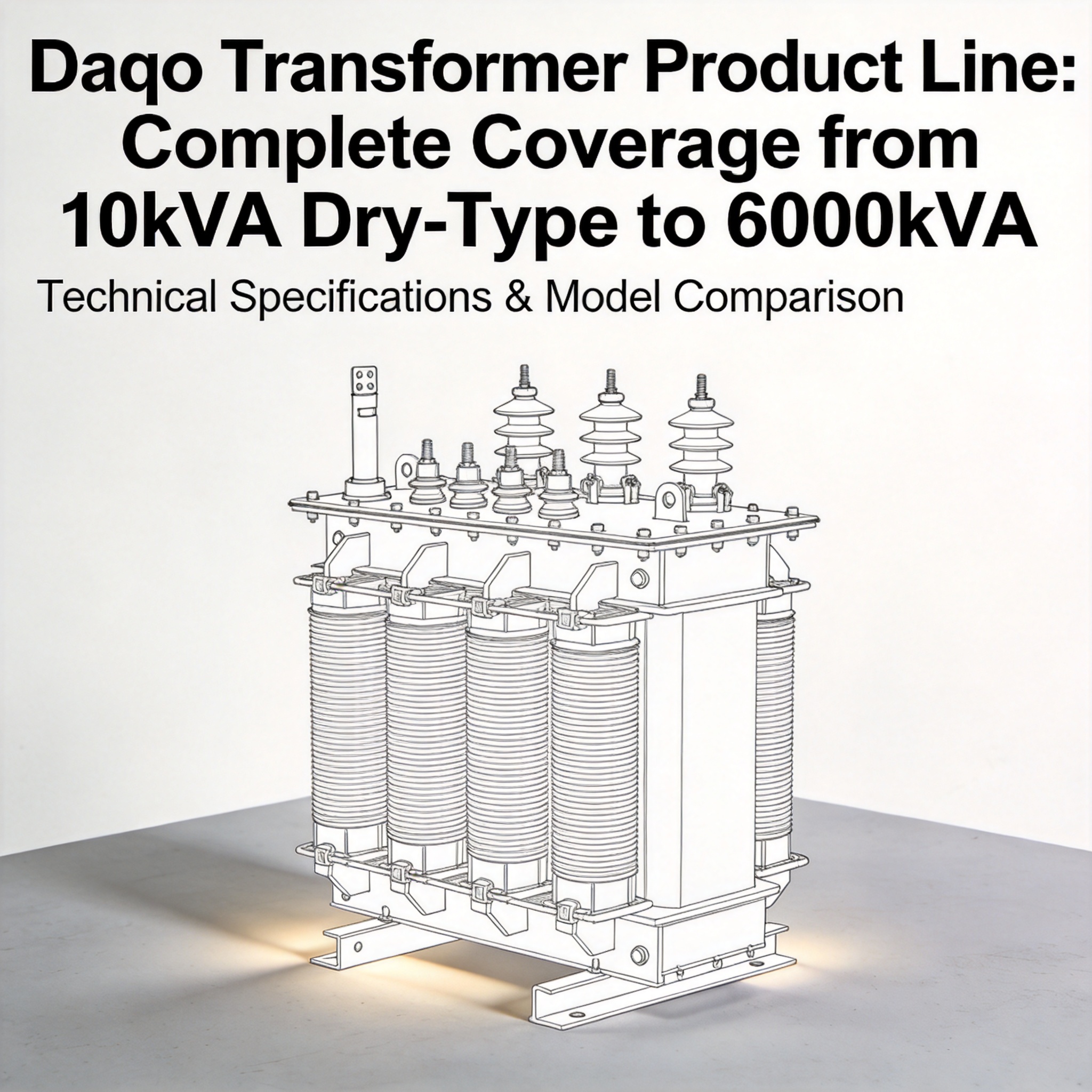
The Daqo transformer product line covers dry-type SCB transformers from roughly 10kVA up to 6000kVA, with high-voltage ratings from 6kV to 35kV and low-voltage outputs from 0.38kV to 0.72kV. If you need to specify, compare, or verify a unit, this guide walks you through the mechanism, the selection steps, the common mistakes, and the questions beginners ask most.
By the end, you will be able to read a Daqo-style transformer datasheet line by line and match a capacity and voltage combination to your load without guessing.
Table of Contents
How a Dry-Type Transformer Covers 10kVA to 6000kVA
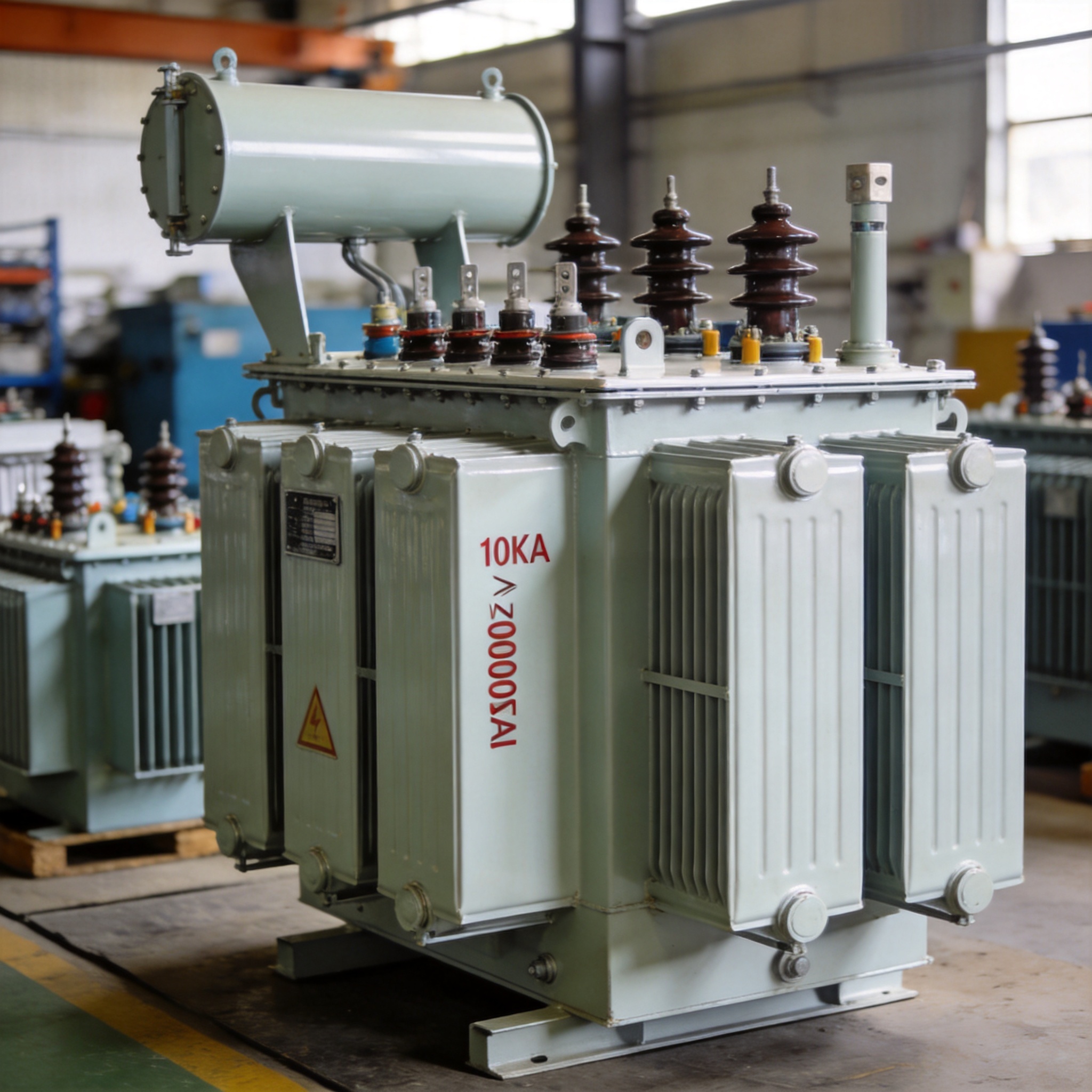
A dry-type transformer transfers electrical energy between two circuits through magnetic induction, with no oil as a cooling medium. The core carries the magnetic flux, the windings carry current, and air plus the insulation system remove heat. Because there is no liquid, the unit suits indoor installation.
Capacity is not a single fixed number but a design window. The same SCB platform scales by changing core cross-section, winding conductor size, number of cooling ducts, and insulation thickness. That is why one product family can span 30kVA to 5000kVA in its standard configuration, with non-standard customization extending the practical range toward 6000kVA.
Voltage rating is independent of capacity. A 500kVA unit can be built for 10kV or 35kV primary, because the insulation level is set by the winding design, not the mass of the core. The table below shows how the two dimensions combine.
| Parameter | Standard Range | Notes |
|---|---|---|
| Capacity | 30–5000 kVA | Non-standard customization supported |
| High voltage | 6, 6.6, 10, 11, 12.47, 13.2, 13.8, 15, 20, 22, 25, 33, 34.5, 35 kV | Single list, choose one |
| Low voltage | 0.38, 0.4, 0.415, 0.433, 0.48, 0.69, 0.72 kV | Matches downstream switchgear |
| Impedance | 4–10% | Affects fault current and regulation |
| Insulation class | F, H | H tolerates higher hotspot temperature |
| Connection group | Dyn11, Yyn0 | Dyn11 is common for distribution |
| Installation | Indoor | Ventilation is mandatory |
| Standards | EN 50588, IEC 60076, UL, CE | Confirm which applies in your market |
Insulation level is the third dimension, and it is the one beginners skip. It defines how much impulse and power-frequency voltage the insulation must withstand, expressed as LI (lightning impulse) and AC (power frequency) values.
| Voltage Class | Insulation Level |
|---|---|
| 10 kV | LI75 AC35 / AC5 |
| 20 kV | LI125 AC50 / AC5 |
| 35 kV | LI170 AC70 / AC5 |
Read this as: at 35kV, the winding insulation must survive a 170kV lightning impulse and a 70kV power-frequency test. If you order a 35kV unit, you cannot substitute a 10kV insulation design, even if the capacity matches.
How to Select a Daqo Transformer, Step by Step
Follow these steps in order. Each one produces a value you carry into the next.
- Calculate your total connected load in kVA. Add the rated apparent power of every downstream load. If you only have kW, divide by the power factor. A 400kW load at 0.8 power factor is 500kVA.
- Apply a growth margin. Multiply by 1.2 to 1.25 for future expansion. 500kVA becomes 600kVA to 625kVA.
- Round up to the nearest standard capacity. Standard steps run 30, 50, 75, 100, 125, 160, 200, 250, 315, 400, 500, 630, 800, 1000, 1250, 1600, 2000, 2500, 3150, 4000, 5000 kVA. Your 625kVA becomes 630kVA.
- Confirm the primary voltage from your utility or upstream feed. Pick exactly one value from the high-voltage list, for example 10kV or 13.8kV. Do not average or approximate.
- Confirm the secondary voltage from your switchgear rating. Pick from 0.38, 0.4, 0.415, 0.433, 0.48, 0.69, or 0.72 kV. In most 400V systems this is 0.4kV.
- Choose the connection group. Use Dyn11 for general distribution where you want a 30-degree phase shift and a neutral for unbalanced loads. Use Yyn0 where the application calls for it.
- Set impedance within 4–10%. Lower impedance gives better voltage regulation but higher fault current. Higher impedance limits fault current but increases voltage drop. Decide based on your breaker interrupting rating.
- Select insulation class F or H. Choose H if ambient temperature is high or ventilation is restricted. Choose F for normal indoor conditions.
- Verify the insulation level matches your voltage class. Use the LI/AC table above. A 20kV unit needs LI125 AC50/AC5.
- Confirm standards and certification. State whether EN 50588, IEC 60076, UL, or CE applies to your project, since testing and documentation differ.
- Confirm indoor installation and ventilation. Calculate the heat loss and verify the room can reject it. Dry-type units are air-cooled, so airflow is not optional.
Worked example: a workshop needs 400kW at 0.8 power factor on a 10kV feed with 400V switchgear. Load is 500kVA, with margin 625kVA, rounded to 630kVA. Primary 10kV, secondary 0.4kV, Dyn11, impedance 6%, insulation class F, insulation level LI75 AC35/AC5, indoor, IEC 60076.
Common Mistakes and How to Fix Them
Mistake 1: Sizing on kW instead of kVA. Symptom: the transformer runs hot and the breaker trips on overload even though the load “should fit.” Fix: always convert to kVA first by dividing kW by power factor, then apply the growth margin. Recheck the arithmetic before ordering.
Mistake 2: Treating voltage and insulation level as the same thing. Symptom: a 35kV unit is ordered but the insulation level quoted is LI75 AC35/AC5, which belongs to the 10kV class. Fix: verify the insulation level against the LI/AC table independently of the voltage figure. At 35kV you need LI170 AC70/AC5.
Mistake 3: Choosing impedance by habit. Symptom: nuisance tripping on downstream breakers, or excessive voltage sag when a large motor starts. Fix: check your breaker interrupting rating first. If it is low, raise impedance toward 8–10%. If voltage regulation is the priority, lower it toward 4–6%.
Mistake 4: Ignoring the indoor ventilation requirement. Symptom: winding temperature rises above the insulation class limit and the unit derates or trips on thermal protection. Fix: calculate heat loss, confirm room airflow, and keep clearance around the enclosure. If airflow cannot be guaranteed, move to insulation class H.
Mistake 5: Assuming a standard catalog value covers a non-standard need. Symptom: the requested combination does not exist in the standard list and the order stalls. Fix: check whether the combination falls inside the standard range first. If it does not, request non-standard customization explicitly and confirm the modified ratings in writing.
FAQ
What is the smallest and largest capacity in this line? The standard configuration spans 30kVA to 5000kVA. Non-standard customization is supported, which extends coverage toward 6000kVA and down toward 10kVA depending on the design.
Can I use a 10kV transformer on a 20kV system? No. The insulation level differs. A 10kV unit is rated LI75 AC35/AC5, while a 20kV unit is rated LI125 AC50/AC5. Using the lower-rated unit on a higher-voltage system exceeds its insulation withstand.
Which connection group should I pick, Dyn11 or Yyn0? For general distribution with unbalanced single-phase loads, Dyn11 is the common choice because it provides a neutral and a 30-degree phase shift. Choose Yyn0 when your application or upstream protection scheme requires it.
What impedance value should I specify? Anything from 4% to 10% is available. Pick the low end for better voltage regulation, and the high end to reduce fault current when your breakers have limited interrupting capacity. There is no universal default.
Do I need class F or class H insulation? Use class F for normal indoor conditions with adequate ventilation. Use class H when ambient temperature is high or airflow is restricted, because it tolerates a higher hotspot temperature.
Which standards apply? The line references EN 50588, IEC 60076, UL, and CE. Which one governs depends on your project location and the authority having jurisdiction. Confirm this before ordering, since test documentation differs by standard.
For the underlying test and insulation requirements, see the International Electrotechnical Commission and the UL Solutions standards directories. For installation and ventilation guidance in North America, the National Fire Protection Association publishes the National Electrical Code, which many jurisdictions adopt.


 English
 Français
 Español
 Deutsch