

Das Herzstück unserer industriellen Anlagen ist der Industrietransformator. Als im Wesentlichen passive Komponente in einer hochkomplexen industriellen Umgebung ermöglicht er die Stromversorgung einer Vielzahl von Industriezweigen und Institutionen. Auch heute, wo Energieeffizienz nicht mehr nur ein theoretisches Konzept, sondern gelebte Praxis ist, wird eine breite Palette von Industrietransformatoren entwickelt, um den Leistungsbedarf industrieller und institutioneller Anwendungen zu decken.
Im vorangegangenen Abschnitt haben wir die Grundlagen industrieller Stromverteilungssysteme erläutert und die Rolle von Industrietransformatoren bei der Verbesserung der Stromverteilungseffizienz durch die Übertragung von Elektrizität zwischen verschiedenen Systemkomponenten angesprochen. Angesichts der oft komplexen Systeme in der Industrie müssen Betreiber, Planer und Einkäufer die vielfältigen Transformatortypen kennen, die weltweit in verschiedenen Branchen eingesetzt werden.
Es ist ebenso wichtig, die Anwendungsbereiche dieser Komponenten für die Stromverteilung und die Kriterien zu verstehen, die bei der Auswahl des geeigneten Geräts für spezifische Stromverteilungsanforderungen zu berücksichtigen sind. Mit diesem Wissen lässt sich die zentrale Rolle von Industrietransformatoren in modernen industriellen Stromverteilungssystemen besser nachvollziehen.

Grundlagen von Industrietransformatoren
Ein Industrietransformator ist eine stationäre elektrische Maschine, die dazu dient, elektrische Energie in Form von Wechselstrom (AC) von einem oder mehreren elektrischen Leitern auf einen oder mehrere andere elektrische Leiter zu übertragen.
Industrietransformatoren übertragen Energie durch elektromagnetische Induktion, wie im Faradayschen Induktionsgesetz beschrieben. Ein sich ändernder magnetischer Fluss in einer geschlossenen Drahtschleife (einer Spule) induziert eine Spannung in einer anderen, nahegelegenen Drahtschleife. Daher kann ein Industrietransformator verwendet werden, um Wechselspannungen zu erhöhen oder zu verringern. Die Übertragungs- oder Betriebsspannung eines Industrietransformators wird entsprechend den Anforderungen der jeweiligen industriellen Anwendung gewählt.
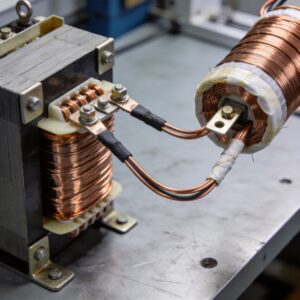
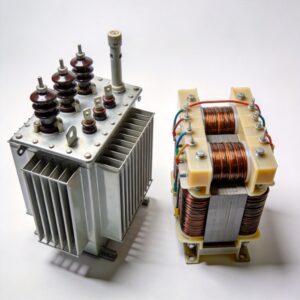
Der Kern eines Industrietransformators besteht typischerweise aus laminiertem Stahl, um den magnetischen Fluss effizient zu lenken. Die Primär- und Sekundärwicklungen bestehen aus zwei oder mehr isolierten Leitern, üblicherweise aus Kupfer oder Aluminium. Diese Leiter sind oft in Windungslagen angeordnet und befinden sich auf gegenüberliegenden Seiten des Kerns.
In Industrietransformatoren treten verschiedene Arten von Verlusten auf:
- Hystereseverluste im Kern
- Wirbelstromverluste im Kern
- I²R (ohmsche) Verluste in der Primär- und Sekundärwicklung
Alle diese Verluste müssen berücksichtigt werden. minimiert, um einen hohen Transformatorwirkungsgrad zu erreichen.
Kühl- und Schutzsysteme
Industrielle Stromverteilungstransformatoren Es handelt sich typischerweise um Hochleistungseinheiten, die zuverlässige Isolationssysteme erfordern. Außerdem benötigen sie Vorkehrungen zur Kühlung der Wicklungen und integrierte Schutzeinrichtungen.
Öltransformatoren
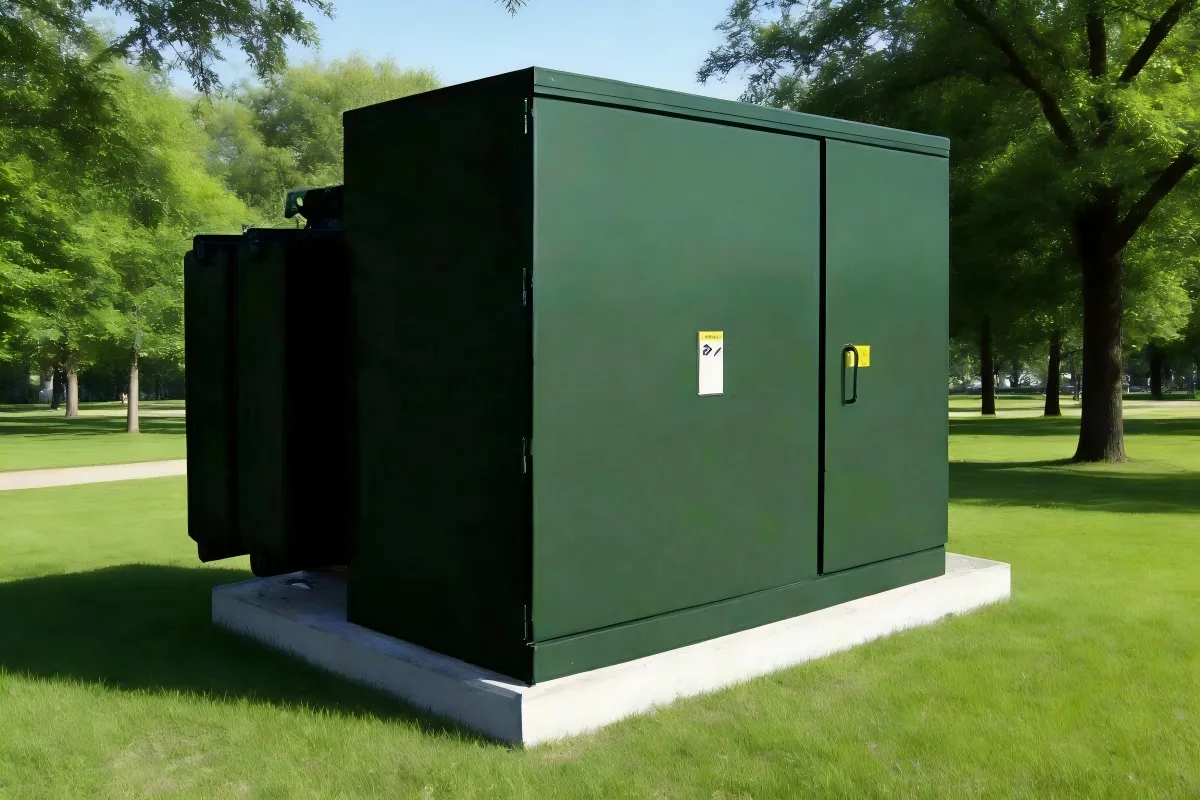
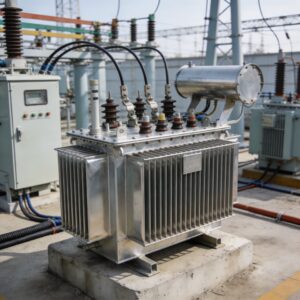
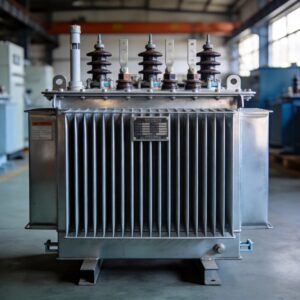
Ölgefüllte Transformatoren Öltransformatoren enthalten Mineralöl, das sowohl als Kühlmittel als auch als Dielektrikum dient. Pumpen zirkulieren das Öl und ermöglichen so die Kühlung der Wicklungen durch Konvektion und Wärmeleitung. Aufgrund der Brandgefahr werden ölgekühlte Transformatoren üblicherweise in Transformatorenräumen im Freien installiert.
Trockentransformatoren
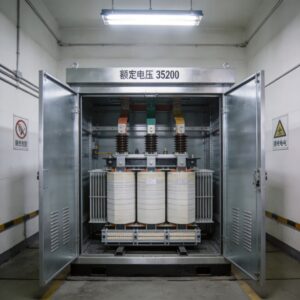
Trockentransformatoren werden im Allgemeinen in Innenräumen, z. B. in Elektroräumen oder Verteilerschränken, installiert. Sie verwenden Luft oder Epoxidharz als Isoliermedium.
Weitere Komponenten können sein:
- Spannungsregler
- Wasserhahnschalter
- Überspannungsableiter
Diese Geräte tragen zur Aufrechterhaltung einer stabilen Ausgangsspannung bei und verbessern den Systemschutz.
Bei der Konstruktion eines Industrietransformators muss auch die Zuverlässigkeit und Wartungsfreundlichkeit Priorität haben, da Ausfälle in anspruchsvollen industriellen Prozessen zu hohen Betriebskosten führen können.
Arten von Industrietransformatoren
Aufwärtstransformatoren
Aufwärtstransformatoren werden üblicherweise in Kraftwerken eingesetzt, um die Spannung des erzeugten Stroms auf Übertragungsniveau zu erhöhen.
Durch die Erhöhung der Spannung verringert sich der Übertragungsstrom, wodurch die Energieverluste bei der Fernübertragung von Energie reduziert werden.
Abwärtstransformatoren
Abwärtstransformatoren reduzieren die Übertragungsspannungen auf niedrigere Verteilungsspannungen, die geeignet sind für:
- Industrielle Maschinen
- Beleuchtungssysteme
- Steuerungseinrichtungen
Diese Transformatoren sind ein wichtiger Bestandteil industrieller Stromverteilungsnetze.
Trenntransformatoren
Trenntransformatoren gewährleisten eine galvanische Trennung zwischen Eingangs- und Ausgangskreisen, wodurch Erdschleifen vermieden und die elektrische Sicherheit verbessert wird.
Sie werden häufig verwendet für:
- Elektrische Prüfung
- Fehlersuche in Schaltkreisen
- Empfindliche elektronische Geräte
Spartransformatoren
Ein Spartransformator verwendet eine einzige Wicklung anstelle von getrennten Primär- und Sekundärwicklungen.
Zu den Vorteilen gehören:
- Kompakte Größe
- Geringere Kosten
- Hohe Effizienz
- Einstellbare Spannungsverhältnisse
Spartransformatoren sind besonders nützlich, wenn große Spannungsanpassungen innerhalb eines relativ kleinen Spannungsbereichs erforderlich sind.
Instrumententransformatoren
Zu den Messwandlern gehören:
Stromwandler (CTs)
Stromwandler messen hohe Ströme präzise für Überwachungs- und Schutzsysteme.
Spannungswandler (PTs)
Spannungswandler messen präzise Spannungspegel und liefern Eingangssignale für Schutzrelais und Messgeräte.
Spezialisierte Industrietransformatoren
Bestimmte Branchen benötigen Spezialtransformatoren, die extrem hohe Leistungspegel bewältigen können.
Beispiele hierfür sind:
Ofentransformatoren
Wird in Elektrolichtbogenöfen verwendet, um die für das Schmelzen und Raffinieren von Metallen erforderlichen massiven Stromstärken zu liefern.
Gleichrichtertransformatoren
Wird zur Bereitstellung von Gleichstrom für industrielle Prozesse verwendet, die Hochstrom-Gleichstromsysteme erfordern.
Bei der Auswahl eines Industrietransformators müssen mehrere Faktoren berücksichtigt werden:
- Primär- zu Sekundärspannungsverhältnis
- Lastcharakteristik
- Erwarteter Arbeitszyklus
- Umweltbedingungen
- Zuverlässigkeitsanforderungen
Anwendungen in der Schwerindustrie
Stahlindustrie
Industrietransformatoren spielen eine entscheidende Rolle in der Stahlproduktion.
Ihre Hauptfunktion besteht in der Bereitstellung der enormen Stromstärken, die für die zum Schmelzen und Verarbeiten von Stahl verwendeten Elektrolichtbogenöfen benötigt werden.
Eine präzise Spannungsregelung ist unerlässlich für:
- Produktionseffizienz
- Produktkonsistenz
- Stahlqualität
Erdölraffinerien
In Erdölraffinerien versorgen Industrietransformatoren folgende Bereiche mit Strom:
- Kompressoren
- Pumps
- Destillationsanlagen
Diese Transformatoren müssen schwankende Lasten bewältigen und gleichzeitig empfindliche Geräte vor Spannungsstörungen schützen.
Bergbau
Für den Einsatz im Bergbau werden häufig Transformatoren in abgelegenen und rauen Umgebungen benötigt.
Industrietransformatoren versorgen folgende Systeme mit Strom:
- Bohrausrüstung
- Brecher
- Fördersysteme
Da es in Bergbauumgebungen staubig, nass, heiß oder extrem kalt sein kann, müssen Transformatoren anspruchsvollen Betriebsbedingungen standhalten.
Trockentransformatoren für den Außenbereich werden häufig eingesetzt, da sie nur minimalen Wartungsaufwand erfordern und auch unter widrigen Bedingungen zuverlässig funktionieren.
In vielen Anwendungen im Bergbau werden Transformatoren eingesetzt. Herunterskalierung der Übertragungsspannungen auf ein Niveau, das den örtlichen Gegebenheiten und Anlagen entspricht.
Rechenzentren
Industrietransformatoren finden auch in Rechenzentren breite Anwendung.
Typische Anwendungsgebiete sind:
- Trenntransformatoren
- Transformatoren für USV-Systeme
- Stromaufbereitungssysteme
Diese Transformatoren gewährleisten den zuverlässigen Betrieb kritischer digitaler Infrastrukturen.
Zukunftstrends und Innovationen bei Industrietransformatoren
Der Markt für Industrietransformatoren entwickelt sich weiter, um dem wachsenden globalen Energiebedarf und den steigenden Effizienzanforderungen gerecht zu werden.
Hochleistungskernmaterialien
Die Forscher untersuchen weiterhin neue Kernmaterialien, darunter:
- Nanokristalline Legierungen
- Amorphe Metalllegierungen
Diese Materialien bieten:
- Geringere Hystereseverluste
- Verbesserte Effizienz
- Bessere Leistung bei Teillast
Die zunehmende Verbreitung von Systemen für erneuerbare Energien und von Frequenzumrichtern (FU) treibt auch die Innovation bei Transformatoren voran.
Intelligente Transformatoren
Intelligente Transformatoren, die mit Sensoren und IoT-Konnektivität ausgestattet sind, werden immer häufiger eingesetzt.
Diese Systeme überwachen:
- Temperatur
- Vibration
- Ölzustand
Die Echtzeitüberwachung ermöglicht vorausschauende Wartung und hilft, unerwartete Ausfälle zu vermeiden.
Digitaler-Zwilling-Technologie
Die Digital-Twin-Technologie erzeugt virtuelle Modelle von physischen Transformatoren.
Zu den Vorteilen gehören:
- Lastsimulation
- Optimierung des Anlagenmanagements
- Verbesserte Wartungsplanung
- Verbesserte betriebliche Effizienz
Fortschrittliche Kühltechnologien
Es entstehen auch neue Kühlmethoden, darunter:
- Flüssigkeitskühlung
- Kryogene Kühlung
Diese Technologien ermöglichen es Transformatoren, extrem hohe Leistungsdichten bei gleichzeitig kompakten Abmessungen zu erreichen.
Folglich eignen sie sich zunehmend für Hochleistungsanwendungen. industrielle Anwendungen wo der Platz begrenzt ist.
Fazit: Das Potenzial industrieller Transformatoren nutzen
Industrietransformatoren, ob groß oder klein, sind weit mehr als nur passive Hardwarekomponenten in einem Stromversorgungssystem. Sie bilden das Herzstück industrieller Stromverteilungsnetze und müssen sicher, effizient und zuverlässig arbeiten, um die industrielle Versorgung mit Strom zu gewährleisten.
Da die Industrie weiterhin nach höherer Effizienz, größerer Zuverlässigkeit und intelligenterem Energiemanagement strebt, werden Industrietransformatoren auch in Zukunft für die Stromverteilung von grundlegender Bedeutung sein.
FAQ
Was ist die Hauptfunktion eines Industrietransformators?
Ein Industrietransformator überträgt elektrische Energie zwischen Stromkreisen mittels elektromagnetischer Induktion und erhöht oder verringert dabei je nach Bedarf die Wechselspannung.
Worin besteht der Unterschied zwischen einem Aufwärts- und einem Abwärtstransformator?
Ein Aufwärtstransformator erhöht die Spannung für eine effiziente Übertragung, während ein Abwärtstransformator die Spannung auf ein für industrielle Anlagen und Einrichtungen geeignetes Niveau reduziert.
Warum werden ölgekühlte Transformatoren im Freien eingesetzt?
Öltransformatoren enthalten Mineralöl, das sowohl als Kühlmittel als auch als Dielektrikum dient. Da Öl eine Brandgefahr darstellt, werden diese Transformatoren üblicherweise im Freien installiert.
Was sind die Vorteile von Trockentransformatoren?
Trockentransformatoren benötigen weniger Wartung, bieten einen verbesserten Brandschutz und eignen sich gut für den Einsatz in Innenräumen.
Wozu dient ein Trenntransformator?
Trenntransformatoren sorgen für eine elektrische Trennung zwischen Stromkreisen, wodurch Erdschleifen vermieden und die Sicherheit von Prüf- und empfindlichen Geräten verbessert wird.

 English
 Français
 Español
 Deutsch