
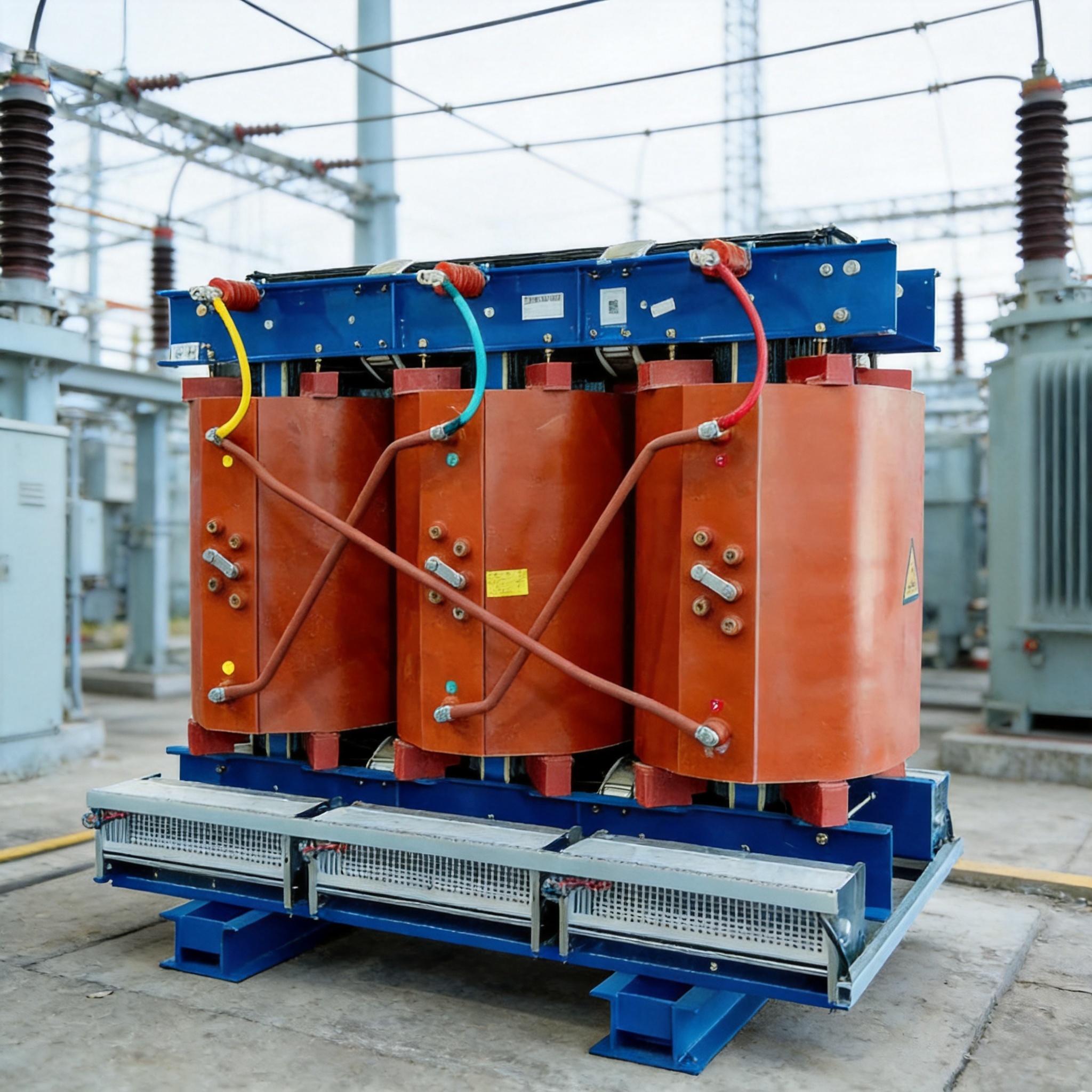
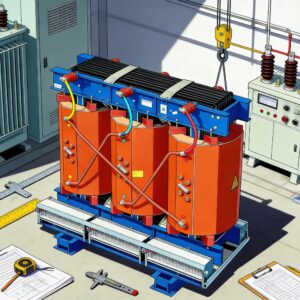
Dry-type transformers are critical for fire safety in data centers because they contain no flammable liquid. Instead of being cooled by oil, they are cooled by air and solid insulation rated Class F or H. If a dry-type transformer overheats or fails internally, there is no oil pool to ignite or spread fire to adjacent racks and cabling. That single design difference is why they are the default choice for indoor data center installations.
After reading this article, you will be able to explain the fire-safety mechanism of a dry-type transformer, specify one correctly for an indoor data center using real SCB-series parameters, and avoid the four most common specification mistakes that compromise fire safety.
Inhaltsübersicht
Why Dry-Type Transformers Resist Fire
The fire-safety advantage comes from what is nicht inside the unit. A liquid-filled transformer uses mineral oil as both coolant and insulator. Mineral oil has a flash point, and a catastrophic internal fault can rupture the tank and release burning oil. A dry-type transformer replaces that liquid with air plus solid insulation materials that are rated to withstand high temperatures without sustaining combustion.
In the SCB-series dry-type transformer, the insulation system is rated Class F or Class H. These are temperature classes for the insulation materials, not a fire rating, but they matter for safety: a Class H system tolerates higher hotspot temperatures before degradation, which reduces the chance of an internal insulation breakdown that could arc. Because the windings are cast or impregnated in solid insulation rather than immersed in oil, there is no combustible liquid inventory in the room.
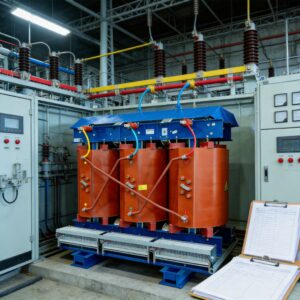
The practical consequence is placement. A dry-type unit can be installed indoors, close to the load, without an oil-containment pit, blast wall, or fire-rated vault. That is why the SCB series is specified for indoor installation and covers a capacity range of 30-5000 kVA — small enough for a floor-level distribution room, large enough for a main data hall feed.
The numbers that matter for safety
Two specification values directly affect how much heat the unit produces and how much fault current it can deliver. Impedance for the SCB series is 4-10%. A lower impedance gives better voltage regulation but higher fault current; a higher impedance limits fault current at the cost of slightly worse regulation. Insulation level defines how much impulse and power-frequency voltage the insulation can take before it breaks down:
| System Voltage | Lightning Impulse (LI) | Power Frequency (AC) |
|---|---|---|
| 10 kV | LI75 | AC35 / AC5 |
| 20 kV | LI125 | AC50 / AC5 |
| 35 kV | LI170 | AC70 / AC5 |
Standard compliance matters because it tells you the unit was tested to a recognized regime. The SCB series is built to EN 50588, IEC 60083, UL, and CE. When you see UL and IEC marks on the nameplate, the dielectric tests behind those insulation-level numbers were performed to a published method rather than an internal one.
How to Specify a Fire-Safe Dry-Type Transformer: 7 Steps
Follow these steps in order. Each one produces a value you carry into the next step, so do not skip ahead.
- Confirm the installation is indoor. Write “indoor installation” on the specification sheet. If the unit will sit outdoors, a dry-type transformer needs a weather-protected enclosure — state that explicitly rather than assuming the base model covers it.
- Select the model family. For a data center distribution room, specify the SCB dry-type family. This fixes the cooling method (air) and the insulation class options (F or H) before you go further.
- Size the capacity in kVA. Choose from the 30-5000 kVA range. Add up your connected load, apply your growth margin, then pick the next standard size up. Do not undersize to save floor space in a room that will only gain load.
- Lock in the voltage ratio. Pick the high-voltage value from 6, 6.6, 10, 11, 12.47, 13.2, 13.8, 15, 20, 22, 25, 33, 34.5, or 35 kV. Pick the low-voltage value from 0.38, 0.4, 0.415, 0.433, 0.48, 0.69, or 0.72 kV. Non-standard combinations are available on request, so match your actual distribution voltage rather than forcing a standard ratio.
- Set the impedance. Choose a value between 4% and 10%. Use the low end when voltage regulation is the priority; use the high end when you need to reduce downstream fault current and your protective devices are rated accordingly.
- Choose the insulation class and connection group. Specify Class F or Class H. Specify Dyn11 oder Yyn0 for the connection group — Dyn11 is the common choice where you want a path for triplen harmonics and a neutral for unbalanced loads.
- State the insulation level and standards on the purchase specification. Write the LI and AC values that match your system voltage (LI75/AC35 for 10 kV, LI125/AC50 for 20 kV, LI170/AC70 for 35 kV) and require compliance with EN 50588, IEC 60083, UL, and CE.
Once these seven values are written down, your specification is complete enough to quote and to compare against a submittal. If any value is missing, the submittal cannot be verified against your fire-safety intent.
Häufige Fehler und wie man sie behebt
These four errors show up repeatedly in data center electrical rooms. Each one has a visible symptom you can catch before installation.
Mistake 1: Assuming “dry-type” means “no fire risk at all”
Symptom: No clearance maintained around the unit, and combustible material stored against the enclosure. Fix: A dry-type transformer removes the oil fire hazard, not every hazard. Keep the manufacturer’s required clearances, keep the room ventilated, and keep combustible storage out. The safety benefit depends on the heat being able to leave the unit.
Mistake 2: Specifying impedance without checking the protection scheme
Symptom: Downstream breakers trip on inrush, or they fail to clear a fault. Fix: Decide impedance (4–10%) and the downstream protective device rating together. A value chosen in isolation will not coordinate with the rest of the system.
Mistake 3: Ordering an outdoor-rated unit for an indoor room, or vice versa
Symptom: The delivered unit does not fit the room, or an indoor unit is installed in a location exposed to weather. Fix: Write the installation condition on the specification before requesting a quote. The SCB series is specified for indoor installation; confirm the enclosure matches the actual location.
Mistake 4: Leaving the insulation level blank on the specification
Symptom: The submittal arrives with no LI or AC values, so you cannot verify the dielectric withstand. Fix: State the required LI and AC values explicitly for your voltage class. If you are unsure which values apply to your system, consult a qualified professional before issuing the specification.
FAQ
Are dry-type transformers really fireproof?
No. They are fire-resistant in the specific sense that they contain no flammable liquid. There is no oil to ignite or spread. Internal faults can still generate heat and smoke, which is why clearance and ventilation requirements still apply.
What insulation class should I choose, F or H?
Both are available on the SCB series. Class H tolerates a higher hotspot temperature than Class F. Choose based on your expected loading profile and ambient temperature, and confirm the choice with a qualified professional if your duty cycle is unusual.
What impedance value is right for a data center?
Any value from 4% to 10% is available. Use a lower value when voltage regulation matters most, and a higher value when you need to limit fault current. Decide this together with your protective device ratings, not separately.
Can I install a dry-type transformer next to the racks?
It must be installed indoors with the manufacturer’s required clearances maintained, in a ventilated space. Placing it directly in a rack row is not appropriate — it belongs in an electrical distribution room or dedicated space.
Which standards should the unit comply with?
The SCB series is built to EN 50588, IEC 60083, UL, and CE. Ask for the compliance documentation with the submittal so you can verify the insulation-level test values against your specification.
For authoritative guidance on transformer installation and fire safety requirements, consult the NFPA codes and standards library und die IEEE Standards Association for the applicable electrical and dielectric test standards in your jurisdiction.

 English
 Français
 Español
 Deutsch