
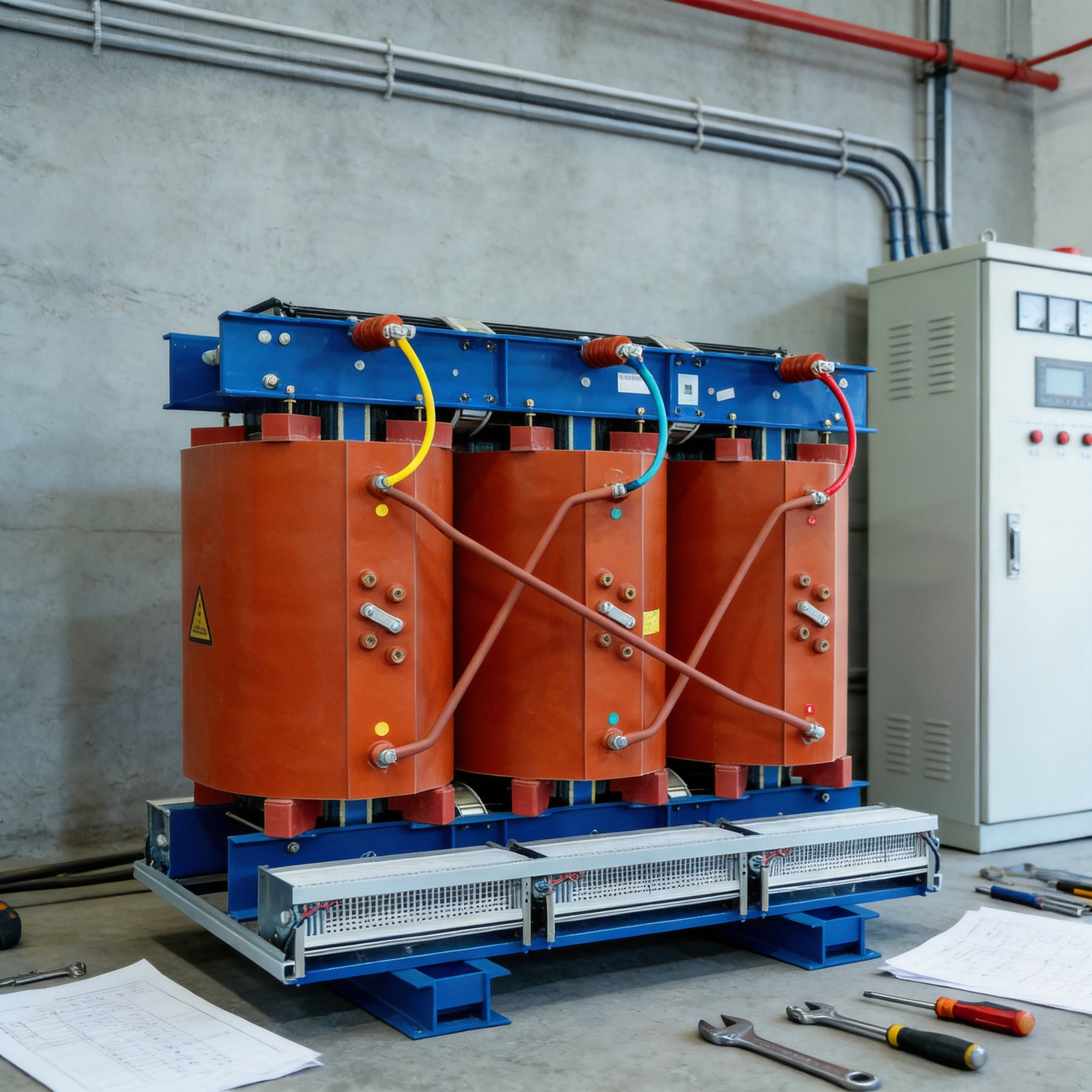
A dry-type transformer cools its windings with air instead of oil. The working principle is simple: current in the primary winding creates a magnetic flux in the core, the flux induces voltage in the secondary winding, and the heat generated by winding resistance and core losses must be removed before insulation degrades. AN (Air Natural) cooling removes that heat by passive convection and radiation only. AF (Air Forced) cooling adds fans that push air across the windings, which raises the allowable load for the same physical unit.
By the end of this article you will be able to read a transformer nameplate, identify whether it is AN, AF, or AN/AF rated, understand why the same transformer has two different kVA ratings, and decide which cooling mode your installation actually needs.
Table of Contents
1. Why It Works: The Cooling Mechanism
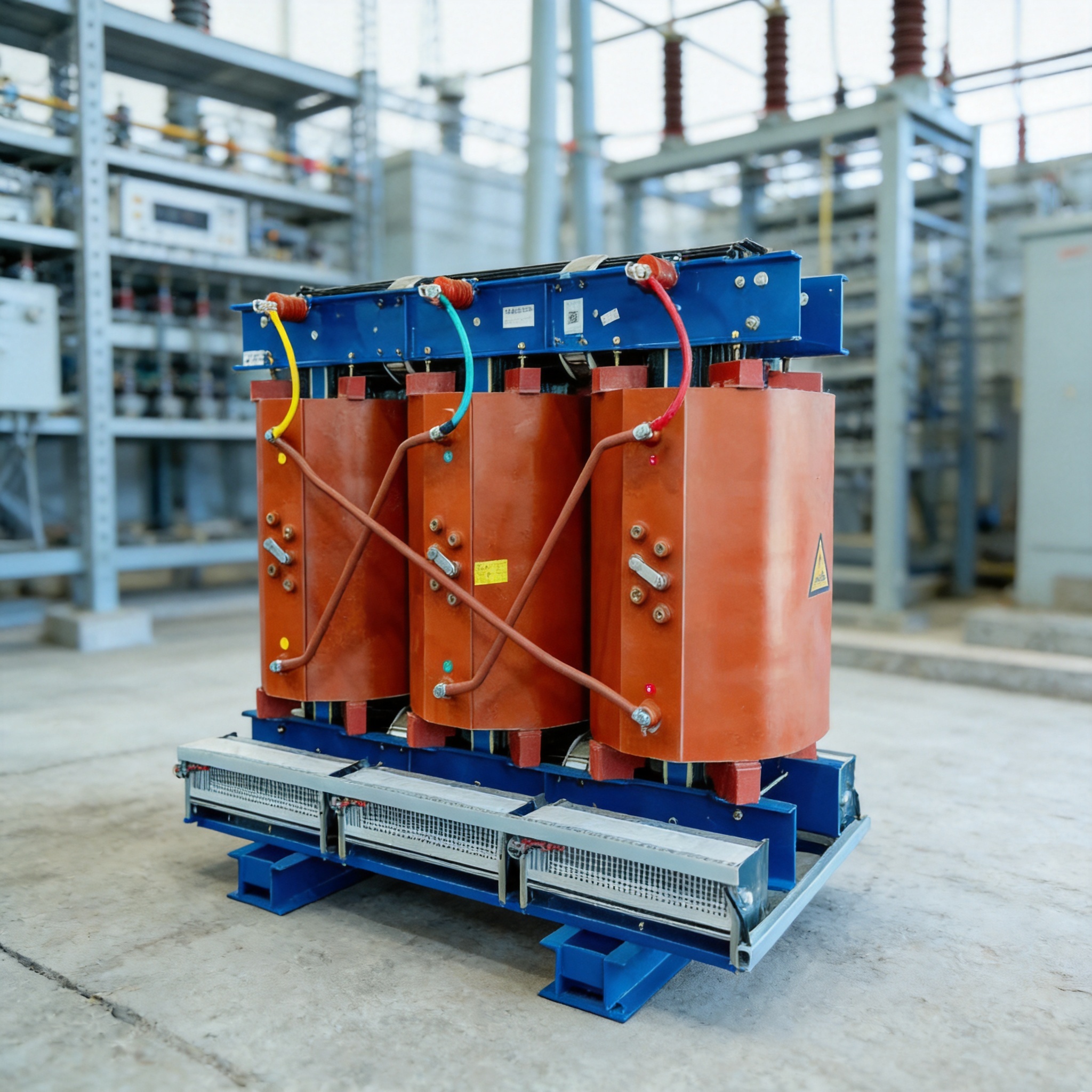
Every dry-type transformer produces heat in two places: the core (eddy current and hysteresis losses) and the windings (I²R losses). That heat travels by conduction to the winding surface, then leaves the surface by convection into the surrounding air. The insulation system has a temperature limit — Class F and Class H are the common ratings — and the transformer’s life depends on staying under that limit.
In AN mode, hot air rises off the winding surfaces and is replaced by cooler room air. There are no moving parts. Cooling depends on the temperature difference between the winding and the ambient air, plus the surface area of the coils. Because the driving force is buoyancy alone, AN cooling has a fixed ceiling on how much heat it can reject.
In AF mode, fans mounted at the base or side of the enclosure force air horizontally or vertically across the winding ducts. Forced convection moves far more air per minute than buoyancy does, so the surface-to-air heat transfer coefficient rises. The result: the same winding can carry more current before hitting its insulation temperature limit. That is why a single unit is often nameplate-rated at two capacities, for example AN 2000 kVA / AF 2500 kVA.
The standards behind these ratings are IEC 60076 and EN 50588, which define how temperature rise is measured and how the AF rating is verified. The reference specification for this class of indoor SCB-type transformer covers 30–5000 kVA, high voltage from 6 kV to 35 kV, low voltage from 0.38 kV to 0.72 kV, impedance 4–10%, insulation class F or H, and connection groups Dyn11 or Yyn0. Insulation levels follow the standard pattern: 10 kV units at LI75 AC35/AC5, 20 kV units at LI125 AC50/AC5, and 35 kV units at LI170 AC70/AC5.
One point beginners miss: AF cooling does not change the transformer’s voltage ratio, impedance, or connection group. It only changes how much heat leaves the unit. The electrical working principle is identical in both modes.
2. How to Determine Your Cooling Mode in 5 Steps
Follow these steps in order. Each one gives you a decision, not a guess.
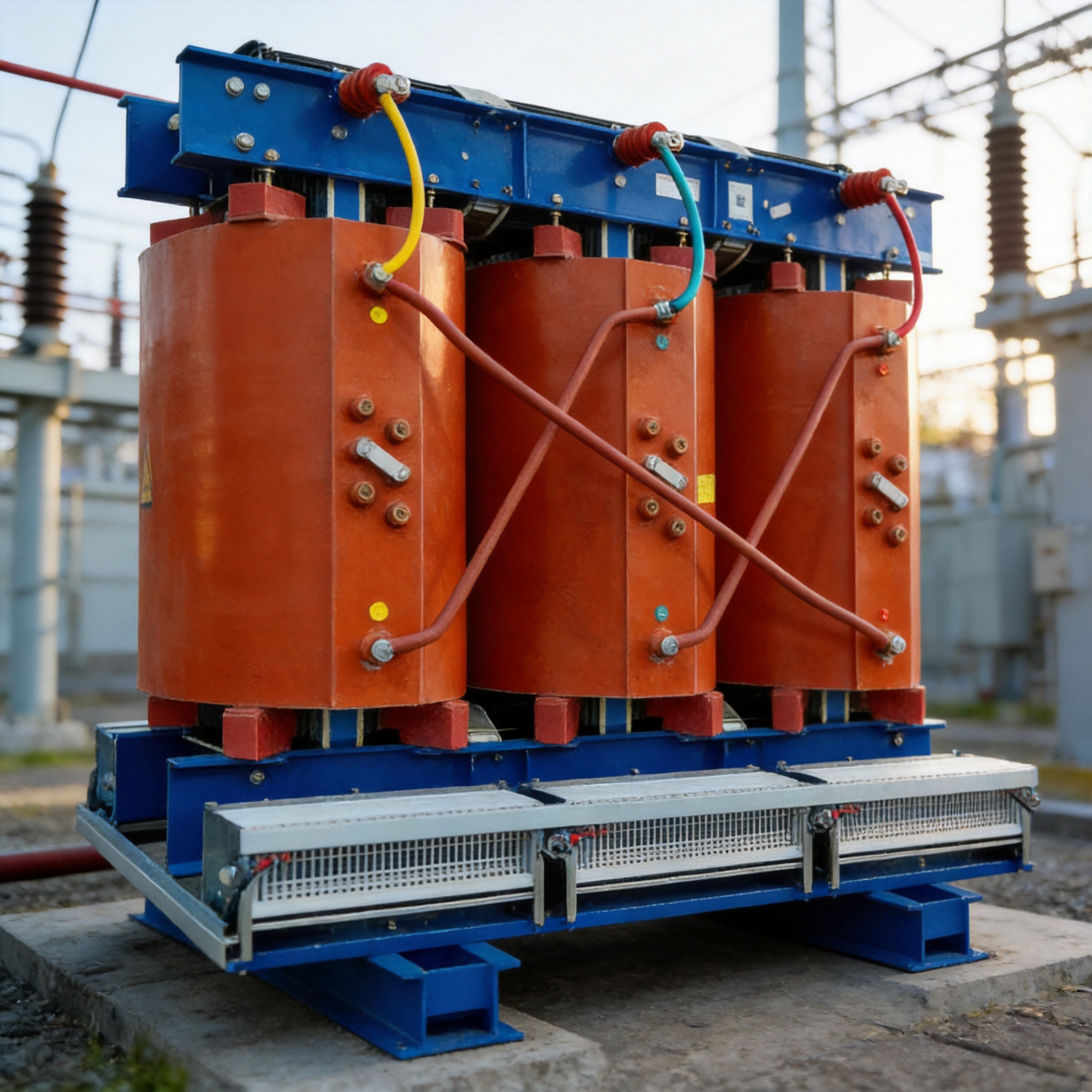
- Read the nameplate kVA field. If it shows a single number, the unit is AN only. If it shows two numbers separated by a slash — for example “AN/AF” or “2000/2500 kVA” — the lower number is the AN rating and the higher number is the AF rating.
- Check the temperature rise columns. A dual-rated unit typically lists two temperature rise values, one per cooling mode. The AF value is usually higher because forced air keeps the winding cooler at the same load. Confirm the values match the standard you are designing to.
- Locate the fan control circuit. AF units have a fan power supply, a contactor, and a temperature sensor or winding temperature indicator (WTI) with a set point. If there is no fan circuit, there is no AF mode regardless of what the sales sheet says.
- Verify the fan set point. The fans should start when winding temperature reaches the manufacturer’s threshold and stop with a time delay on cooldown. Write down the actual set point from the relay or controller display.
- Confirm the AF rating is only used with fans running. Treat the AF kVA number as unavailable when fans are off or failed. Size your protection and cable for the AN rating as the baseline, and confirm the AF rating is only claimed with proven airflow.
Here is the practical comparison that matters on site:
| Parameter | AN (Air Natural) | AF (Air Forced) |
|---|---|---|
| Heat removal method | Passive convection + radiation | Fans + forced convection |
| Moving parts | None | Fans, contactor, control circuit |
| Rated capacity | Base rating (lower kVA) | Increased rating (higher kVA) |
| Noise | Core noise only | Core noise + fan noise |
| Maintenance | Dust cleaning only | Dust cleaning + fan and bearing checks |
| Failure mode | Gradual overtemperature | Fan failure silently removes AF capacity |
| Typical use | Normal continuous load | Peak load, short-term overload, high ambient |
If your load profile stays under the AN rating year-round, AN alone is sufficient and you can leave the fans as backup. If your load exceeds the AN rating during predictable peaks, AF lets you avoid buying a larger transformer — but only if the fans are maintained.
3. Common Mistakes and How to Fix Them
Mistake 1: Loading to the AF rating with the fans off.
Symptom: winding temperature climbs past the AN limit during a peak, and the unit trips or the insulation ages faster than expected. Fix: interlock the load management or alarm system so the AF kVA rating is only assumed when fan-running status is confirmed. If fan status is not available, derate to the AN number.
Mistake 2: Blocking the ventilation path.
Symptom: even in AN mode the transformer runs hotter than the design value, and the AF mode delivers less improvement than expected. Fix: keep the clearance around the enclosure and the inlet/outlet grilles clear. Dust buildup on winding ducts has the same effect — clean the ducts on a scheduled interval.
Mistake 3: Ignoring fan failure alarms.
Symptom: fans stop, no one notices, and the transformer silently loses its AF capacity. The first sign is a temperature alarm during the next peak. Fix: wire fan failure and fan-running status to the monitoring system, and test the fans during routine maintenance.
Mistake 4: Assuming AF changes impedance or connection group.
Symptom: someone expects different short-circuit behavior or a different vector group in AF mode. Fix: remember that impedance (4–10% per the reference specification) and connection group (Dyn11 or Yyn0) are fixed by the winding design. Cooling mode changes only the thermal limit.
Mistake 5: Using AF to cover a high-ambient installation without checking the temperature rise basis.
Symptom: the AF rating was calculated for a standard ambient, but the room is hotter, so the actual safe load is lower. Fix: verify the ambient the rating assumes and consult a qualified professional before relying on AF capacity in an unusually hot room.
4. FAQ
What does AN mean on a transformer nameplate?
AN means Air Natural: the transformer is cooled by passive air convection only, with no fans. The kVA number listed for AN is the capacity the unit can carry continuously in that mode.
What does AF mean, and is it always available?
AF means Air Forced: fans push air across the windings to remove more heat, allowing a higher kVA rating. It is only available while the fans are running. If the fans fail, the unit reverts to its AN rating.
Can I run an AN/AF transformer continuously in AF mode?
Yes, provided the fans are maintained and the ambient temperature matches the rating basis. Many operators run AF only during peaks to extend fan life, which is a valid strategy as long as temperature limits are respected.
Does AF cooling reduce transformer losses?
No. Losses are set by the core and winding design and the load current. AF only improves heat removal, which raises the allowable load before the insulation temperature limit is reached.
Which standard governs the AN and AF ratings?
IEC 60076 and EN 50588 define transformer rating and temperature-rise testing. Units in this class are commonly built to those standards, with UL and CE marking for the relevant markets. Always confirm the specific standard cited on your nameplate.
For the underlying rating and testing framework, see the International Electrotechnical Commission and the UL Solutions standards portals.
Disclosure: this article is an educational explanation of cooling principles. It contains no product recommendations and no commercial relationships.

 English
 Français
 Español
 Deutsch